NeoLife Salmon Oil Plus:
Purity Standards, Omega-3 Science, and the Eight-Fatty-Acid Formulation
Editorial Note: This article examines the scientific rationale and research record behind NeoLife Salmon Oil Plus. All cited studies are published in indexed scientific journals or conducted at accredited research institutions. No unverified health claims are made. Statements about cardiovascular health, omega-3 fatty acids, and cellular function have not been evaluated by the Food and Drug Administration. This product is not intended to diagnose, treat, cure, or prevent any disease.
The Omega-3 Gap: Why It Matters and How Large It Is
Long-chain omega-3 fatty acids — primarily eicosapentaenoic acid (EPA) and docosahexaenoic acid (DHA) — are among the most extensively researched nutrients in clinical nutrition. Over decades of epidemiological observation and controlled clinical trials, low omega-3 status has been consistently associated with measurable differences in cardiovascular markers, inflammatory response, neurological function, and immune cell activity. The research record supporting omega-3 supplementation spans thousands of published studies across multiple independent research institutions on multiple continents.
Yet despite this research volume, omega-3 deficiency remains one of the most prevalent nutritional gaps in industrialized populations. National dietary surveys in the United States, Europe, and Australia consistently document average EPA and DHA intake well below the levels associated with measurable health benefits in the clinical literature. The American Heart Association, the European Food Safety Authority, and the World Health Organization have all issued guidance on omega-3 intake that the majority of adults in western countries do not meet through diet alone.
The dietary gap is structural, not incidental. The primary source of EPA and DHA is cold-water fatty fish — salmon, mackerel, sardines, anchovies, and herring. These species accumulate long-chain omega-3s from their marine diet in concentrations that no land-based food source replicates. In traditional coastal populations consuming these fish multiple times weekly, omega-3 status is measurably higher and cardiovascular outcomes measurably better across multiple studies. In populations eating the processed, land-food-dominated diets characteristic of most industrialized nations, the cold-water fish intake that would close this gap is largely absent.
The alternative frequently proposed — increasing intake of plant-based omega-3 sources such as flaxseed, walnuts, or chia — does not solve the problem. These sources provide alpha-linolenic acid (ALA), a short-chain omega-3 that the body must convert to EPA and DHA to deliver the biological effects documented in the clinical research. Human conversion efficiency from ALA to EPA is estimated at below 10%, and conversion to DHA is even lower. For practical purposes, plant-based omega-3 sources cannot substitute for direct EPA and DHA intake from marine sources.
Why Purity Is the Central Challenge in Fish Oil Supplementation
Establishing the biological value of omega-3 fatty acids is not the scientific challenge in fish oil supplementation — that case has been made thoroughly across decades of published research. The challenge is purity.
Cold-water fish sit near the top of the marine food chain. They accumulate lipid-soluble environmental contaminants from the smaller organisms they consume, which in turn have accumulated contaminants from their food sources. This bioaccumulation means that the fatty tissues of cold-water fish — precisely the fraction from which fish oil is derived — concentrate environmental pollutants including methylmercury, polychlorinated biphenyls (PCBs), dioxins, furans, and organochlorine pesticide residues.
Crude fish oil, before refinement, contains measurable levels of these compounds. The degree to which a finished fish oil supplement has addressed this contamination burden depends entirely on the manufacturing and testing protocols applied — and these vary enormously across the supplement industry. A fish oil supplement that lists impressive EPA and DHA totals on its label may simultaneously deliver a meaningful dose of PCBs or dioxins if purity verification has been inadequate.
This is not a theoretical concern. Independent testing of commercial fish oil supplements has repeatedly found contamination levels that vary by orders of magnitude between products with similar label claims. The consumer purchasing a fish oil supplement based on EPA and DHA content alone has no visibility into the purity verification — or lack thereof — behind the product.
NeoLife’s Purity Standard: 200+ Contaminants, Zero Tolerance
Salmon Oil Plus is screened against more than 200 potential contaminants with a zero-tolerance philosophy. This testing scope reflects NeoLife’s Scientific Advisory Board (SAB) Purity standard applied specifically to the contamination challenges of marine-sourced ingredients.
The SAB was established in 1976 by Dr. Arthur Furst — founder of the Stanford Cancer Chemotherapy Laboratory and internationally recognized pioneer in toxicology and cancer research. Furst’s background in toxicology and disease prevention science directly informed the SAB’s approach to ingredient purity: contamination at any level in a supplement intended for daily long-term consumption is not an acceptable trade-off for nutritional benefit. The zero-tolerance framework reflects this position.
The 200+ contaminant screening panel goes substantially beyond the categories addressed in standard food safety testing. Heavy metals including mercury, lead, cadmium, and arsenic are tested alongside the full spectrum of PCB congeners, dioxins, furans, brominated flame retardants, and organochlorine pesticide residues. This breadth of testing reflects the reality that marine contamination is not limited to the most commonly publicized pollutants — and that bioaccumulation in cold-water fish creates a complex contamination profile that narrow testing panels do not adequately characterize.
The nutritional benefit of omega-3 fatty acids is only realized if the delivery vehicle is clean. Salmon Oil Plus treats purity verification not as a regulatory compliance exercise but as a prerequisite for the product to do what it is designed to do.
Eight Omega-3 Fatty Acids: The Whole-Food Principle Applied to Fish Oil
Most fish oil supplements report two numbers: EPA content and DHA content. These are the two long-chain omega-3 fatty acids with the most extensive individual research records, and they are the primary reason most consumers seek omega-3 supplementation. Reporting them as a combined total or individually is the industry standard.
Salmon Oil Plus delivers standardized amounts of eight different omega-3 fatty acids — not just EPA and DHA. This reflects the same whole-food principle that guides Tre-en-en Grain Concentrates and Carotenoid Complex: the biological effects observed in populations consuming whole dietary sources of a nutrient reflect the complete molecular profile present in those sources, not isolated compounds extracted from them.
Cold-water salmon contains EPA and DHA as its dominant omega-3 fatty acids, but also docosapentaenoic acid (DPA), eicosatetraenoic acid (ETA), stearidonic acid (SDA), alpha-linolenic acid (ALA), heneicosapentaenoic acid (HPA), and additional omega-3 variants in smaller but biologically relevant concentrations. Each of these fatty acids has distinct metabolic fates and biological roles. DPA, for example, is a precursor to specialized pro-resolving mediators — lipid compounds involved in resolving inflammatory responses — that EPA and DHA alone do not fully account for.
When the SAB formulated Salmon Oil Plus to deliver all eight omega-3 fatty acids in standardized amounts, the reasoning was consistent with the formulation logic applied across NeoLife’s foundational products: the research consistently points to whole dietary sources, not to the single most-studied compound extracted from those sources. EPA and DHA supplementation in isolation replicates the most studied components of fish oil. Eight-omega-3 supplementation replicates the actual omega-3 profile of the food source the research was originally built on.
| Omega-3 Fatty Acid | Abbreviation | Primary Biological Role |
|---|---|---|
| Eicosapentaenoic acid | EPA | Cardiovascular health, eicosanoid precursor, immune modulation |
| Docosahexaenoic acid | DHA | Neuronal membrane structure, retinal function, brain development |
| Docosapentaenoic acid | DPA | Precursor to specialized pro-resolving mediators; EPA/DHA elongation intermediate |
| Stearidonic acid | SDA | Converts efficiently to EPA; supports cardiovascular markers |
| Eicosatetraenoic acid | ETA | Eicosanoid pathway modulation |
| Alpha-linolenic acid | ALA | Short-chain omega-3; precursor to longer-chain fatty acids |
| Heneicosapentaenoic acid | HPA | Minor omega-3; present in marine food chain lipid profile |
| Additional marine omega-3 variants | — | Complete cold-water fish lipid profile; whole-food matrix replication |
Omega-3 Fatty Acids and Cell Membrane Biology
The connection between omega-3 supplementation and cardiovascular health is the most widely cited research finding in the field. Less frequently discussed — but equally important from the SAB’s cellular nutrition framework — is the role omega-3 fatty acids play in cell membrane composition and function.
EPA and DHA are highly unsaturated fatty acids — they contain multiple double bonds in their carbon chains, which gives them a distinctive kinked molecular shape. When these fatty acids are incorporated into the phospholipid bilayer of cell membranes, they reduce membrane packing density and increase fluidity. This is not an incidental effect. It directly influences the activity of membrane-embedded proteins: ion channels, transport proteins, receptors, and enzymes whose function depends on their ability to change conformation within the membrane.
In neuronal cells, DHA constitutes a substantial fraction of membrane phospholipids — it is one of the dominant fatty acids in brain grey matter and retinal cells. Membrane DHA content affects synaptic transmission, neurotransmitter receptor sensitivity, and the speed of signal propagation along neuronal membranes. In immune cells, EPA and DHA content influences the inflammatory signaling capacity of the cell — high omega-3 membrane content shifts the eicosanoid production profile toward less pro-inflammatory mediators.
This membrane-level mechanism connects Salmon Oil Plus directly to the broader Pro Vitality+ system design. Tre-en-en Grain Concentrates addresses cell membrane composition through grain phytosterols and lipids. Salmon Oil Plus addresses the same membrane through its polyunsaturated fatty acid fraction. Carotenoid Complex provides fat-soluble antioxidant protection for the lipid structures in that same membrane. Three components, three distinct molecular mechanisms, one shared cellular target: the integrity and functional efficiency of the cell membrane bilayer.
The Cardiovascular Research Record
The clinical evidence supporting omega-3 fatty acids and cardiovascular health represents one of the most robust bodies of research in nutritional science. Large-scale epidemiological observations — beginning with landmark studies of Greenlandic Inuit populations by Bang and Dyerberg in the 1970s — established the association between high dietary fish intake, high omega-3 status, and markedly lower rates of cardiovascular events compared to age-matched populations consuming Western diets.
Subsequent controlled clinical trials have examined the mechanisms behind this association. EPA and DHA supplementation produces measurable reductions in serum triglycerides — a well-established cardiovascular risk marker — across multiple randomized controlled trials. The triglyceride-lowering effect is dose-dependent and reproducible across diverse study populations. Additional research has examined effects on blood pressure, platelet aggregation, arterial compliance, and endothelial function, with findings generally consistent with cardiovascular benefit.
The mechanism most clearly established is triglyceride reduction. EPA and DHA suppress hepatic triglyceride synthesis and increase triglyceride clearance through lipoprotein lipase-mediated pathways. At doses of 2–4 grams of combined EPA and DHA daily, triglyceride reductions of 15–30% have been documented in multiple clinical trials in individuals with elevated baseline levels — an effect size comparable to pharmaceutical lipid-modifying agents for this specific marker.
Salmon Oil Plus is clinically proven to support heart and cardiovascular health — a claim grounded in this extensive research record. The formulation delivers the fatty acid profile and potency level supported by this literature, in a delivery format — softgel with the oil matrix itself as the delivery vehicle — that maintains bioavailability by keeping the omega-3 fatty acids in their native triglyceride or phospholipid form rather than as ethyl esters, which require re-esterification in the gut before absorption.
The SAB Standard Applied to Marine Ingredients
NeoLife’s Scientific Advisory Board applies three core standards across all product development: Purity, Potency, and Proof. For marine-sourced ingredients, Purity carries particular weight — the contamination challenges of fish oil are more complex than those of most other supplement ingredients, and the consequences of inadequate testing are more serious given the bioaccumulative nature of the pollutants involved.
The SAB’s approach to Salmon Oil Plus reflects Dr. Arthur Furst’s toxicological perspective: the question is not only whether a substance provides benefit, but whether it does so without introducing harm. A fish oil supplement that delivers documented omega-3 benefits alongside meaningful PCB or dioxin exposure is not an acceptable product under this framework. The 200+ contaminant screening protocol is the operational expression of this position.
Potency, the second SAB standard, is addressed through the standardization of all eight omega-3 fatty acids to defined levels — not through a generic “fish oil 1000mg” label claim that says nothing about the actual fatty acid profile or its biological potency. Every batch is tested to verify that the stated omega-3 profile is present at the levels the formulation specifies.
Proof, the third standard, is addressed through NeoLife’s alignment with the published clinical research on omega-3 fatty acids and cardiovascular health — one of the most extensively documented areas of nutritional science — combined with the formulation decisions (eight fatty acids, zero-tolerance purity) that reflect the SAB’s interpretation of what that research actually supports.
Practical Considerations
Fat-soluble delivery: Omega-3 fatty acids are absorbed via the same pathway as dietary fats — they require bile acids for emulsification and are packaged into chylomicrons for transport through the lymphatic system. Taking Salmon Oil Plus with a meal containing dietary fat optimizes absorption. The softgel format helps maintain omega-3 fatty acids in a protected, oxidation-resistant environment prior to ingestion.
Oxidation and freshness: Omega-3 fatty acids are highly unsaturated — their multiple double bonds make them susceptible to oxidation when exposed to heat, light, or oxygen. Oxidized fish oil not only loses potency but may generate oxidative byproducts. The softgel format, combined with appropriate antioxidant inclusion and manufacturing controls, protects fatty acid integrity through the product’s shelf life.
Consistency of use: Plasma omega-3 levels — measured as the omega-3 index, the percentage of EPA and DHA in red blood cell membranes — respond to supplementation over weeks to months of consistent use, not days. The omega-3 index is now recognized as a more clinically relevant marker of omega-3 status than acute plasma measurements, precisely because it reflects the longer-term incorporation of EPA and DHA into cell membranes. Consistent daily supplementation is the relevant variable for achieving and maintaining meaningful omega-3 status.
As part of the Pro Vitality+ system: Salmon Oil Plus is one of four components in the Pro Vitality+ foundational nutrition system, alongside Tre-en-en Grain Concentrates, Carotenoid Complex, and the Essential Vitamin & Mineral Complex. The SAB designed these four products to address complementary cellular nutrition gaps simultaneously. Salmon Oil Plus is also available as a standalone product for those adding omega-3 supplementation to an existing regimen.
How Neolife Salmon Oil Plus Compares: An Eight-Point Benchmark Analysis
In February 2025, NeoLife published a comparative analysis benchmarking Salmon Oil Plus against eight competing omega-3 products across the direct selling and mainstream supplement markets — including Herbalife, Shaklee, Amway Nutrilite, doTERRA, Nature’s Sunshine, NatureMade, Nordic Naturals, Garden of Life, and Sports Research. The comparison evaluated eight criteria derived from the SAB’s formulation standards.
The results are unambiguous. Salmon Oil Plus was the only product in the comparison to meet all eight criteria simultaneously. No competing product came close across the full benchmark.
| Benchmark Criterion | NeoLife Salmon Oil Plus | Herbalife Herbalifeline | Shaklee OmegaGuard | Amway Nutrilite | doTERRA EO Mega+ | Nature’s Sunshine | NatureMade | Nordic Naturals | Sports Research |
|---|---|---|---|---|---|---|---|---|---|
| Standardized omega-3s on label | 8 | 2 | 7 | 3 | 2 | 2 | 2 | 2 | 2 |
| Clinically tested product | ✓ | ✗ | ✗ | ✗ | ✗ | ✗ | ✗ | ✗ | ✗ |
| At least 460mg EPA per serving | ✓ | ✗ | ✗ | ✓ | ✗ | ✗ | ✓ | ✓ | ✓ |
| At least 480mg DHA per serving | ✓ | ✗ | ✗ | ✓ | ✗ | ✗ | ✗ | ✗ | ✗ |
| At least 50mg DPA per serving | ✓ | ✗ | ✗ | ✗ | ✗ | ✗ | ✗ | ✗ | ✗ |
| At least 80mg other omega-3s per serving | ✓ | ✗ | ✗ | ✓ | ✓ | ✗ | ✗ | ✗ | ✓ |
| Certified sustainably sourced fish oil | ✓ | ✗ | ✗ | ✓ | ✗ | ✗ | ✓ | ✓ | ✓ |
| 100% wild-caught fish | ✓ | ✗ | ✓ | ✓ | ✓ | ✗ | ✓ | ✓ | ✓ |
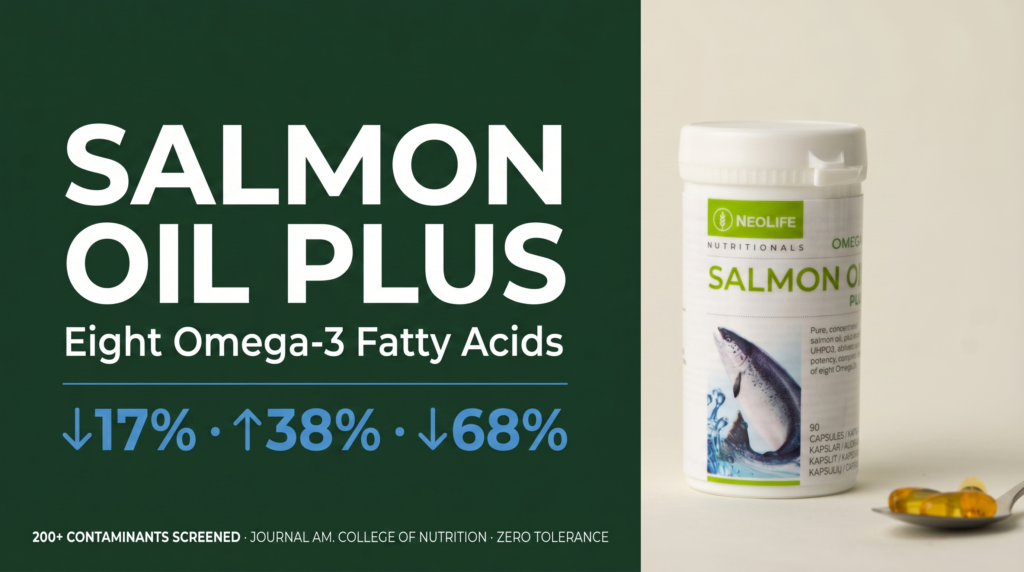
Two findings in this comparison deserve specific attention. First, the clinical testing row: Salmon Oil Plus is the only product in this nine-product comparison that has been clinically tested as a finished product. Every competing product received a negative mark on this criterion — meaning their omega-3 content may be accurately labeled, but the finished formulation has not been subject to human clinical trials documenting real-world outcomes. The 17% triglyceride reduction, 38% omega-3 index improvement, and 68% inflammatory marker reduction documented for Salmon Oil Plus represent outcomes that no competing product in this comparison can point to with equivalent evidence.
Second, the DPA criterion: Salmon Oil Plus was the only product across all nine competitors to deliver at least 50mg of docosapentaenoic acid (DPA) per serving. Every other product received a negative mark. This is not a minor omission — DPA is a precursor to specialized pro-resolving mediators involved in resolving inflammatory responses, and its absence from competing formulations reflects the industry’s continued focus on EPA and DHA totals at the expense of the complete omega-3 profile that whole dietary fish provides.
Frequently Asked Questions
Why does Neolife Salmon Oil Plus deliver eight omega-3 fatty acids instead of just EPA and DHA?
EPA and DHA are the most extensively studied omega-3 fatty acids, but cold-water salmon contains a full spectrum of long-chain omega-3s — including DPA, SDA, ETA, ALA, HPA, and additional variants — each with distinct metabolic roles. The health outcomes associated with high fish consumption in epidemiological research reflect the complete omega-3 profile of the food source, not EPA and DHA in isolation. NeoLife’s Scientific Advisory Board formulated Salmon Oil Plus to deliver all eight standardized omega-3 fatty acids present in high-quality salmon oil — consistent with the whole-food principle applied across NeoLife’s foundational products — rather than isolating the two most-studied compounds and ignoring the rest of the molecular profile.
What does “screened against 200+ contaminants” actually mean?
It means every batch of Salmon Oil Plus is tested against a panel of more than 200 potential environmental contaminants before release. This panel includes heavy metals (mercury, lead, cadmium, arsenic), the full spectrum of PCB congeners, dioxins and furans, brominated flame retardants, and organochlorine pesticide residues. Cold-water fish bioaccumulate these compounds from their marine food chain, meaning crude fish oil extracts contain measurable contamination that must be removed and verified through manufacturing and testing. The 200+ contaminant panel goes substantially beyond standard food safety testing requirements, reflecting NeoLife’s SAB zero-tolerance position: omega-3 benefit is only meaningful when delivered without concurrent contaminant exposure.
Can I get enough omega-3 from flaxseed or walnuts instead of fish oil?
Plant-based omega-3 sources including flaxseed, walnuts, and chia provide alpha-linolenic acid (ALA) — a short-chain omega-3 that the body must convert to EPA and DHA to deliver the biological effects documented in cardiovascular and neurological research. Human conversion efficiency from ALA to EPA is estimated below 10%, and conversion to DHA is substantially lower. For practical purposes, plant-based omega-3 sources cannot substitute for direct long-chain EPA and DHA intake from marine sources. The clinical research on omega-3 and cardiovascular health was built on EPA and DHA — not ALA — and the dose-response relationships established in that research apply to direct EPA and DHA intake, not to ALA supplementation.
How does Neolife Salmon Oil Plus support cardiovascular health?
The cardiovascular research on EPA and DHA spans decades of clinical investigation. The most consistently documented mechanism is triglyceride reduction: EPA and DHA suppress hepatic triglyceride synthesis and increase clearance, producing dose-dependent triglyceride reductions of 15–30% in clinical trials at intakes of 2–4 grams combined EPA and DHA daily. Additional research has examined effects on blood pressure, platelet aggregation, arterial compliance, and endothelial function. The epidemiological foundation — observations of populations with high cold-water fish intake showing markedly different cardiovascular outcomes compared to populations with low fish intake — dates to landmark studies of Greenlandic Inuit populations in the 1970s and has been replicated and extended in populations worldwide since.
How does Neolife Salmon Oil Plus fit into the Pro Vitality+ cellular nutrition system?
All four Pro Vitality+ components address cell membrane composition and function through distinct mechanisms. Tre-en-en Grain Concentrates supplies grain phytosterols and lipids that maintain membrane structural integrity. Salmon Oil Plus supplies EPA and DHA — the polyunsaturated fatty acids that determine membrane fluidity in neuronal and immune cells. Carotenoid Complex supplies fat-soluble antioxidants that protect membrane lipids from oxidative damage. The Essential Vitamin and Mineral Complex supports the enzymatic machinery that synthesizes and maintains these membrane structures. Salmon Oil Plus addresses the omega-3 fraction of the membrane lipid environment — a target that Tre-en-en does not cover, because grain lipids and sterols address a different part of the membrane composition spectrum.
Why does the omega-3 index matter more than plasma omega-3 measurements?
The omega-3 index measures EPA and DHA as a percentage of total fatty acids in red blood cell membranes. Because red blood cells have a lifespan of approximately 120 days, their membrane fatty acid composition reflects omega-3 intake over the preceding months — not just the hours before the test. This makes it a stable, clinically relevant indicator of long-term omega-3 status and membrane incorporation. Plasma omega-3 measurements, by contrast, reflect recent intake and fluctuate with meals, making them poor indicators of whether omega-3 fatty acids are actually being incorporated into cell membranes at the levels associated with measurable health outcomes in the clinical literature. Consistent daily Salmon Oil Plus supplementation over weeks to months is required to meaningfully shift the omega-3 index.
The Research Record in Summary
NeoLife Salmon Oil Plus addresses the omega-3 gap that is among the most prevalent and quantifiable nutritional shortfalls in industrialized diets — with a formulation designed to do so without the contamination trade-off that undermines lesser fish oil products. Eight standardized omega-3 fatty acids replicate the complete molecular profile of high-quality cold-water fish oil. Screening against 200+ contaminants with zero tolerance applies the SAB’s Purity standard at the level the marine sourcing challenge demands. And clinical proof of cardiovascular support is grounded in one of the most extensively documented areas of nutritional research.
For those evaluating Salmon Oil Plus as part of a foundational nutrition approach, full product information is available through the NeoLife shop and the NeoLife Scientific Advisory Board documentation. The complete cellular nutrition system that includes Salmon Oil Plus is covered in the Pro Vitality+ system overview.
* These statements have not been evaluated by the Food and Drug Administration. This product is not intended to diagnose, treat, cure, or prevent any disease. Research citations are provided for informational purposes. Individual results may vary.