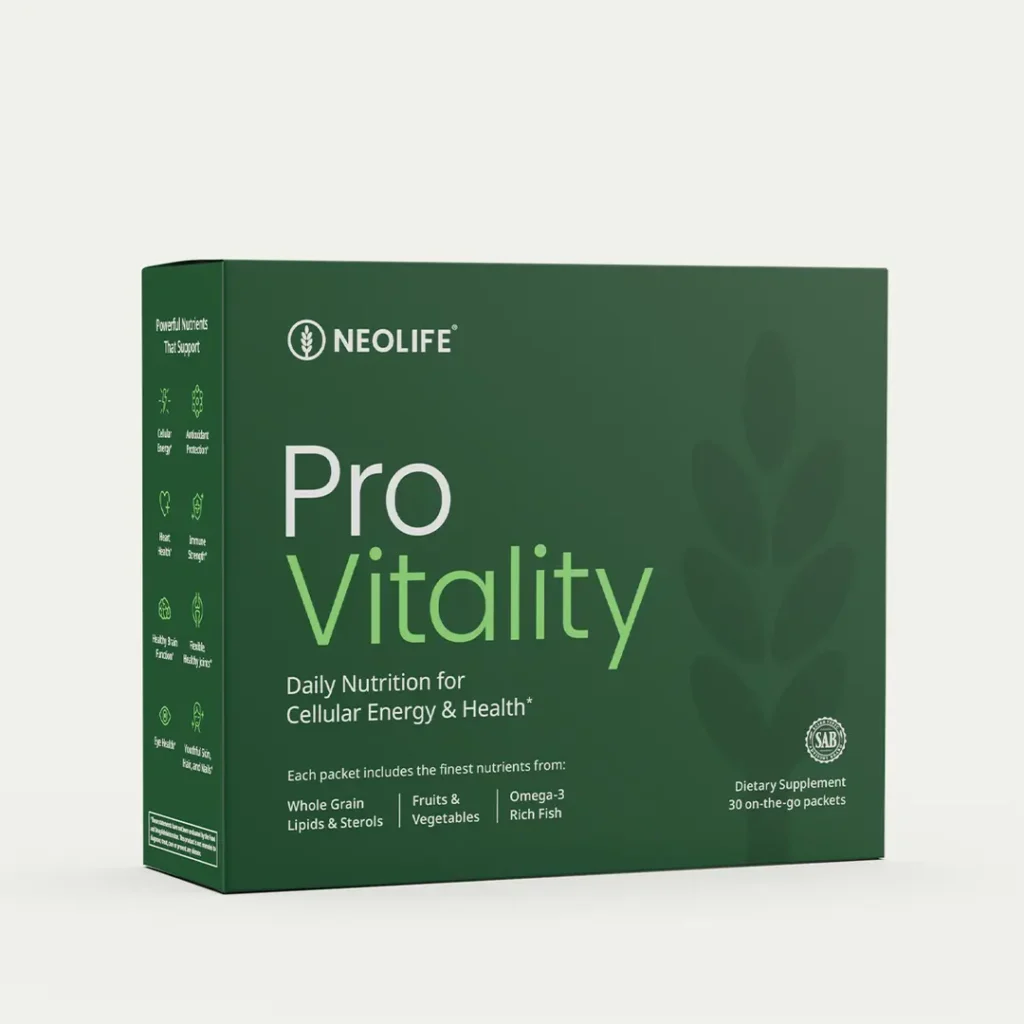
Neolife Pro Vitality is the product that SAB Director John Miller calls the one where all the stories behind the stories come together. Most supplement companies build a multivitamin and call it foundational. Neolife built Pro Vitality from a different starting point entirely — not from a label, but from decades of research into what is actually missing from modern diets at the cellular level, and what the clinical evidence says happens when those gaps are filled.
Pro Vitality is four products in one: Tre-en-en Grain Concentrates, Carotenoid Complex, Omega-3 Salmon Oil Plus, and a proprietary Essential Vitamin and Mineral Complex with phytoenzymes. Each of these components has its own research history, its own peer-reviewed publication record, and its own story of how it came to exist. Understanding Pro Vitality means understanding all four — and why the combination matters more than any single ingredient.
What follows draws directly on presentations by three SAB members who have been involved in this science for decades: Susan Beck Ph.D., who presented Pro Vitality at a Neolife rally; Arianna Carughi Ph.D., whose published research on carotenoids and omega-3s underpins two of the four components; and John R. Miller, SAB Director, who was present for much of the original research that led to these formulations.
The Problem Pro Vitality Was Built to Solve
What Modern Diets Are Actually Missing
The starting point for Pro Vitality is not a nutrient deficiency in the traditional sense. It is not about scurvy or rickets — diseases of acute vitamin absence. It is about something more subtle and more widespread: the gap between what modern diets provide and what cells require to function efficiently over a lifetime.
Approximately 84% of Americans eat processed rather than whole grains. That means the vast majority of the population is missing the lipid and sterol fraction that whole grains contain — compounds that cell membranes require to maintain the flexibility needed for efficient nutrient transport and waste removal. A diet that meets standard vitamin and mineral recommendations can still leave cells operating below their potential if the membrane lipid profile is compromised.
The fruit and vegetable picture is similarly stark. The CDC estimates that approximately 90% of Americans do not meet the recommended five daily servings of fruits and vegetables. Research published by a global partnership including Imperial College London, Harvard Medical School, and Mount Sinai found that between 5.6 and 7.8 million premature deaths per year from cancer and cardiovascular disease may be preventable by consuming ten servings of fruits and vegetables daily — twice the standard recommendation that most people are already failing to meet.
Pro Vitality was formulated to address these specific gaps: the missing grain lipids and sterols, the missing carotenoids from colorful fruits and vegetables, the missing omega-3 fatty acids from fatty fish, and the micronutrient shortfalls that remain even in otherwise adequate diets.
Component One: Tre-en-en Grain Concentrates
The Origin Story That Most People Have Never Heard
Tre-en-en is described in Neolife literature as the world’s first phytonutrient supplement, introduced in 1958. What is less widely known is why it was originally developed. According to Susan Beck’s SAB presentation, Tre-en-en was created for a hospital research study on chronic fatigue — an application that speaks directly to the cellular energy premise at the heart of the product’s design.
The formulation provides lipid extracts from three whole-grain sources: GMO-free wheat, soy, and rice. It is, as Beck notes, literally the only product on the marketplace with this specific combination of three oils. The choice of sources was not arbitrary — wheat germ oil, rice bran oil, and soy provide complementary profiles of essential fatty acids and phytosterols that together support cell membrane structure in ways that no single source replicates.
What the Science Actually Shows
Phytosterols are structurally similar to cholesterol. When consumed, they compete with cholesterol for absorption in the digestive system — a mechanism that recent research has quantified in useful terms. Rice bran oil has been found in clinical research to reduce total cholesterol by 10% and LDL cholesterol by 8.5%. Wheat germ oil and rice bran oil have both demonstrated anti-inflammatory and antioxidant effects in the body.
The practical implications of the lipid and sterol deficiency go beyond cholesterol management. As Beck explains, healthy fats are critical for the absorption of fat-soluble nutrients from food. Eating a salad of raw vegetables without fat produces very limited absorption of carotenoids like beta-carotene, lycopene, and lutein. Eating the same salad with healthy fat increases carotenoid absorption by two and a half to fifteen times. Vitamin D absorption increases by 32% when consumed with healthy fats. This means Tre-en-en is not simply a standalone supplement — it is a nutrient efficiency multiplier for everything else consumed alongside it.
The Texas A&M University research conducted in 1987 compared animals fed standard chow meeting vitamin and mineral requirements against animals whose standard lipid fraction was replaced with Tre-en-en grain concentrates. Despite identical caloric intake, the Tre-en-en group showed superior growth, faster maturation, better cardiovascular development, and higher adrenal activity — interpreted as evidence of improved nutrient utilization efficiency rather than increased energy intake.
Component Two: Carotenoid Complex
How the Research Actually Happened
John Miller’s account of how Carotenoid Complex came to exist is one of the most detailed origin stories in Neolife’s scientific history — and it explains why the product is genuinely different from what the rest of the supplement industry produced in response to the same data.
The starting point was the National Health and Nutrition Examination Survey (NHANES) — the USDA’s large-scale analysis of what Americans eat and what happens to their health. Within that data, a clear pattern emerged: people who consumed the most colorful fruits and vegetables had the greatest probability of health and the lowest risk of many diseases. The inverse was equally clear. The compounds responsible were identified as carotenoids — the lipid-soluble pigments in carrots, tomatoes, spinach, red bell peppers, peaches, strawberries, and apricots.
The supplement industry’s response was to produce synthetic beta-carotene. Neolife’s SAB rejected that approach. As Miller explains, the evidence did not say that isolated synthetic beta-carotene produced the benefits — it said that people who ate diets rich in carotenoid-containing foods experienced the benefits. The logical response was to go to those foods, extract the bioactive carotenoids, and deliver them in that form.
The next step was proving bioavailability — that the extracted carotenoids actually reached the bloodstream in their active forms. A human clinical trial measured plasma carotenoid concentrations before and after supplementation and confirmed that they did. That result, as Miller notes, had never been demonstrated before for extracted food-derived carotenoids delivered in capsule form. It was published in the American Journal of Clinical Nutrition — which brought Neolife to the attention of USDA researchers.
The USDA Research Program
The USDA researchers who engaged with Neolife following the American Journal of Clinical Nutrition publication conducted a series of clinical studies that produced three findings. First, they confirmed bioavailability — replicating the plasma carotenoid results independently. Second, they showed that while carotenoids were present in the bloodstream, there was a measurable reduction in oxidative events on LDL cholesterol molecules. Third, in a follow-up study, they demonstrated that carotenoids taken up by cells over time reduced the risk of oxidative events on cell membranes.
The program culminated in research showing that even short-term supplementation could boost key markers of immune function. As Susan Beck summarizes in her presentation: Neolife’s Carotenoid Complex was studied by USDA researchers and found to boost immune capacity by 37% in 20 days by increasing lymphocytes including natural killer cells. Lymphocytes — which include T cells, B cells, and natural killer cells — are among the most important components of the immune system’s defensive capacity.
Carotenoid Complex provides at least 15 important carotenoids from carrots, red bell peppers, tomatoes, spinach, apricots, strawberries, and peaches. Each capsule provides the equivalent phytonutrients found in a typical serving of carotenoid-rich fruits and vegetables.
Component Three: Omega-3 Salmon Oil Plus
Eight Omega-3s, Not Two
The standard industry approach to omega-3 supplementation focuses on EPA and DHA — the two fatty acids most prominently featured in cardiovascular health research. Neolife’s SAB took a different position based on the same food-first logic that shaped Carotenoid Complex.
As John Miller explains, research identified eight omega-3 fatty acids involved in human nutrition, each playing important roles individually and synergistically. Delivering only EPA and DHA, Miller argues, is like playing a song on a piano with keys missing — you can make some sounds but not the full composition. Salmon Oil Plus was formulated to provide all eight, standardized to their natural ratios as they occur in wild salmon from pristine North Atlantic waters.
The bioavailability research on Salmon Oil Plus was published in the Journal of the American College of Nutrition, which brought Neolife to the attention of Carsten Groaner at UC Berkeley — a researcher focused specifically on how omega-3s resolve inflammation. Groaner’s research demonstrated that Neolife Salmon Oil Plus has the ability to dramatically increase compounds called resolvins — the chemicals the body uses to resolve inflammatory responses — and that this led to more complete healing.
SAB member Arianna Carughi’s study on Salmon Oil Plus produced specific measurable outcomes: triglycerides reduced by 17%, the omega-3 index improved by 38%, and an important cellular inflammatory marker reduced by 68%. The inflammatory marker reduction reflects an improved ratio of arachidonic acid — a pro-inflammatory fatty acid — to EPA, an anti-inflammatory fatty acid, in cellular membranes.
The research on Salmon Oil Plus eventually reached the National Institute of Health, where director Emily Chu referenced Neolife’s data in an article in the New England Journal of Medicine. Of three scientific references cited, Neolife’s work was the only human clinical data — the other two references were animal studies.
Component Four: Essential Vitamins, Minerals, and Phytoenzymes
The fourth component of Pro Vitality addresses micronutrient gaps that remain even in diets where the lipid, carotenoid, and omega-3 deficits are being addressed. The World Health Organization estimates that approximately 30% of the global population — over two billion people — experience some form of micronutrient deficiency.
The proprietary blend provides 21 essential vitamins and minerals at levels designed to supplement the diet rather than substitute for food. Critically, phytoenzymes are included to support optimal digestion — recognizing that nutrient delivery depends not only on what is consumed but on whether the digestive system can effectively process and release those nutrients for absorption.
The Polyphenol Dimension: What Pro Vitality Connects To
In her SAB presentation on polyphenols, Arianna Carughi describes a category of compounds that she and John Miller have been researching for over 30 years — and whose importance has expanded dramatically in that time.
Polyphenols — the most abundant and diverse group of health-protective compounds in fruits and vegetables — were initially studied as antioxidants. Research over the subsequent three decades has revealed that their benefits extend far beyond antioxidant activity. They function as signaling molecules, modulating enzyme pathways that regulate energy metabolism, lipid metabolism, glucose metabolism, and immune function. They have demonstrated anti-inflammatory capacity. And in the most recent research, they are showing connections to cognitive protection that were not anticipated when the work began.
Dr. Giulio Pasinetti from Mount Sinai — a researcher whom Carughi describes as having presented at PhenHRIG multiple times — has demonstrated that polyphenols promote beneficial gut bacteria, which in turn metabolize polyphenols into active compounds that cross the blood-brain barrier. These metabolites appear to promote neurogenesis, protect neurons, increase cerebral blood flow, and reduce neuroinflammation. Population studies including the PREDIMED trial have linked high-polyphenol diets to lower rates of cognitive decline, particularly in verbal and language memory.
This emerging gut-brain connection explains something that puzzled researchers for years: how anthocyanins — a group of polyphenols that are poorly absorbed as intact compounds — could produce measurable health benefits throughout the body. The answer, now becoming clear, is that the gut microbiome metabolizes them into active compounds that are highly bioavailable and reach tissues that the parent compounds could never access directly.
Pro Vitality’s carotenoid and whole-food components contribute to polyphenol diversity. Products like Flavonoid Complex and Cruciferous Plus extend this further — and Neolife’s 25-year involvement with PhenHRIG, which Carughi and Miller helped found, keeps the SAB at the frontier of this research as it continues to develop.
What a 30-Day Supply of Pro Vitality Actually Represents
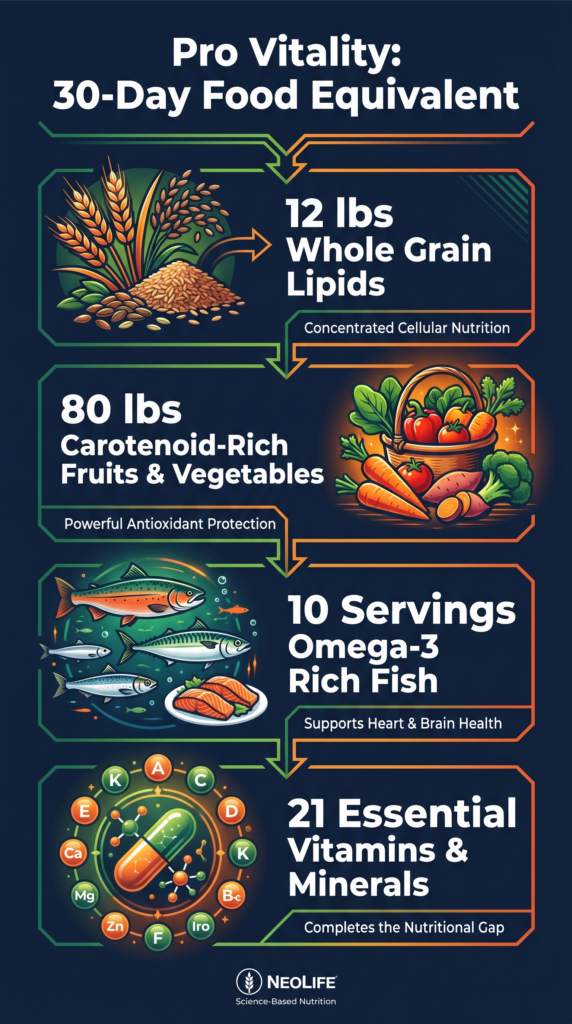
| Component | Food Equivalent per 30-Day Supply | Primary Benefit |
|---|---|---|
| Tre-en-en | 12 pounds of whole grain lipids and sterols | Cell membrane flexibility, nutrient transport efficiency |
| Carotenoid Complex | 80 pounds of carotenoid-rich fruits and vegetables | Antioxidant protection, immune support, cellular health |
| Salmon Oil Plus | 10 servings of omega-3 rich fish | Cardiovascular health, inflammation resolution, brain function |
| Vitamin and Mineral Complex | 21 essential micronutrients | Bridges dietary gaps, supports phytoenzyme digestion |
Neolife Pro Vitality vs. Standard Multivitamins
| Criteria | Pro Vitality | Standard Multivitamin | Fish Oil + Multivitamin Stack |
|---|---|---|---|
| Cellular membrane support | Yes — Tre-en-en lipids and sterols | No | Partial — omega-3 only |
| Mixed carotenoid complex | Yes — 15+ from whole food sources | Beta-carotene only, often synthetic | Beta-carotene only, often synthetic |
| Full omega-3 spectrum | Yes — 8 omega-3s standardized | No | Usually EPA/DHA only |
| Peer-reviewed bioavailability proof | Yes — multiple journals | Rarely | Varies |
| USDA-partnered clinical research | Yes | No | No |
| New England Journal of Medicine reference | Yes — Salmon Oil Plus data | No | No |
| Phytoenzymes for digestion support | Yes | Rarely | No |
Who Pro Vitality Is Designed For
Anyone who is not eating ten servings of colorful fruits and vegetables daily. According to global research cited by Susan Beck, ten servings — not five — is the threshold associated with meaningful reductions in premature death from cancer and cardiovascular disease. With 90% of Americans failing to reach even five servings, Carotenoid Complex within Pro Vitality addresses a gap that is nearly universal.
Anyone eating processed rather than whole grains. With 84% of Americans consuming processed grains, the lipid and sterol fraction that Tre-en-en provides is missing from the vast majority of diets. The implications are not only for cellular membrane health but for the efficiency with which all other nutrients — from food and supplements — are absorbed and utilized.
People focused on healthy aging and cognitive function. The emerging research on polyphenols, carotenoids, and omega-3s increasingly points toward long-term protection against the chronic inflammatory processes associated with cognitive decline, cardiovascular disease, and metabolic dysfunction. Pro Vitality’s components address the nutritional foundations that this research consistently identifies as protective.
Active people and athletes. The cellular energy premise of Tre-en-en, the inflammation-resolving capacity of Salmon Oil Plus, and the antioxidant protection of Carotenoid Complex are all relevant to people whose physical demands accelerate the processes that good nutrition is meant to support.
Families looking for a single foundational product. As Susan Beck noted in her presentation, Pro Vitality is family-friendly — her nine-year-old son takes the Neolife shake. The foundational nutrition premise means that Pro Vitality is designed as the base upon which all other supplementation is built, making it relevant across age groups rather than targeted at a specific demographic.
Frequently Asked Questions
What is Neolife Pro Vitality?
Pro Vitality is Neolife’s foundational supplement — four products combined into one daily packet: Tre-en-en Grain Concentrates, Carotenoid Complex, Omega-3 Salmon Oil Plus, and an Essential Vitamin and Mineral Complex with phytoenzymes. Each component addresses a specific nutritional gap common in modern diets and has its own peer-reviewed research history. All four products are also sold separately.
Why does Pro Vitality include grain concentrates?
Tre-en-en was originally developed for a hospital research study on chronic fatigue and introduced in 1958 as the world’s first phytonutrient supplement. Modern grain processing removes the lipid and sterol fraction from whole grains — compounds that cell membranes require for flexibility and efficient nutrient transport. Tre-en-en restores those compounds from wheat germ, rice bran, and soy in a combination found in no other product on the market.
What makes Neolife’s Carotenoid Complex different from a standard beta-carotene supplement?
Standard supplements typically provide synthetic beta-carotene — a single isolated compound. Neolife’s Carotenoid Complex provides at least 15 carotenoids extracted from whole food sources: carrots, red bell peppers, tomatoes, spinach, apricots, strawberries, and peaches. The formulation reflects the SAB’s principle that the benefits observed in people who eat carotenoid-rich diets come from the full spectrum of compounds in those foods, not from any single isolated carotenoid. USDA-partnered research has confirmed bioavailability and documented a 37% increase in immune capacity in 20 days in clinical research.
Why does Pro Vitality use salmon oil specifically?
Neolife’s SAB identified eight omega-3 fatty acids involved in human nutrition — not just EPA and DHA. Salmon Oil Plus is standardized to all eight, sourced from wild salmon in North Atlantic waters, and tested for over 200 contaminants including mercury, lead, and PCBs. One capsule provides the omega-3 equivalent of approximately two and a half servings of fatty fish per week. SAB research published in the Journal of the American College of Nutrition demonstrated a 17% reduction in triglycerides, 38% improvement in omega-3 index, and 68% reduction in a cellular inflammatory marker.
What is the New England Journal of Medicine connection?
Research on Neolife Salmon Oil Plus conducted in collaboration with UC Berkeley researcher Carsten Groaner was referenced by National Institute of Health director Emily Chu in an article in the New England Journal of Medicine. Of three scientific references cited in that context, Neolife’s work was the only human clinical data — the other references were animal studies.
What are phytoenzymes and why are they in Pro Vitality?
Phytoenzymes are plant-derived enzymes that support digestion — the process by which nutrients are released from food and made available for absorption. Their inclusion in Pro Vitality reflects the SAB’s consistent position that nutrient delivery depends not only on what is consumed but on whether the digestive system can effectively process it. Supplementing with nutrients that the body cannot efficiently absorb addresses only part of the problem.
Can Pro Vitality replace a healthy diet?
No supplement replaces a healthy diet — a position the SAB has maintained consistently. Pro Vitality is designed to address specific nutritional gaps that are common even in otherwise reasonable diets, and to support the efficiency with which nutrients from food are absorbed and utilized. As Susan Beck emphasizes, eating fatty fish and colorful fruits and vegetables remains important regardless of supplementation. Pro Vitality supplements those efforts rather than substituting for them.
Summary: The Foundation Beneath Everything Else
Pro Vitality’s claim to be foundational is not marketing language. It reflects a specific formulation logic: before addressing targeted health goals through additional supplementation, the cellular infrastructure that determines how efficiently all nutrition is used should be in place. Membrane lipids and sterols, mixed carotenoids from whole food sources, a complete omega-3 spectrum, and a micronutrient baseline — these are the elements that decades of SAB research have consistently identified as the gaps most likely to limit nutritional outcomes in modern populations.
The research record behind each component — from the original Tre-en-en hospital study in 1958 to the New England Journal of Medicine reference for Salmon Oil Plus — is one of the most extensively documented in the direct-selling nutrition industry. It exists not because Neolife funded studies designed to produce favorable outcomes, but because the SAB’s approach of working with USDA researchers, university scientists, and independent research groups produced results that were published in peer-reviewed journals and attracted further scientific attention on their own merits.