
Editorial Note: This page examines NeoLife NeoFit90 program in the context of peer-reviewed research on 90-day weight management, glycemic response control, meal replacement efficacy, and cellular nutrition. NeoLife product data reflects manufacturer-published specifications and SAB-associated clinical research. General weight management research is cited from PubMed/PMC. No therapeutic claims are made. Individual results vary. This content is not medical advice.
Table of Contents
NeoFit90 weight loss program is a structured intervention that applies GR2 Glycemic Response Control Technology within a Core3 nutritional framework combining NeoLifeShake, Pro Vitality+, and targeted support products. Unlike generic 90-day calorie-restriction programs, NeoFit90 addresses weight management at three simultaneous levels: glycemic response (via GR2 protocol and meal composition), protein delivery (via NeoLifeShake’s 18g complete protein in 160 calories), and cellular nutrition (via Pro Vitality+’s four-component system addressing the nutritional gaps that affect metabolic efficiency during caloric restriction). The program’s 90-day duration is not arbitrary: peer-reviewed habit formation research places the median behavioral consolidation period at 66 days, meaning a 90-day framework captures full habit formation and provides a critical consolidation window in the final three weeks.
| NeoFit90 Component | Key Specification | Research Support | Mechanism |
|---|---|---|---|
| GR2 Technology | Glycemic Response Control protocol | Clinical study: avg. 5.27 lb / 12 weeks; Dr. Todd Miller, Texas A&M | Modulates insulin response → shifts metabolism toward fat utilization |
| NeoLifeShake | 18g protein, 160 cal, PDCAAS >1.0, all 22 amino acids, 5g fiber | Meta-analysis: meal replacements −6.13 kg vs. diet alone (Astbury 2019, n=7,884) | Complete protein + fiber → satiety + glycemic stability + lean mass preservation |
| Pro Vitality+ | 4 components: Tre-en-en, Carotenoid Complex, Salmon Oil Plus, Essential V&M | USDA-partnered; Am. J. Clin. Nutr. 1994 (PMID 8147336); NEJM omega-3 reference | Cell membrane integrity → improved nutrient transport + metabolic efficiency |
| 90-Day Duration | Full program timeframe | Habit stabilization: 66 days median (JMIR PMC11641623, 2024) | Captures full habit formation + consolidation window |
What Is NeoFit90 weight loss program and How Is It Structured?
NeoFit90 is structured around NeoLife’s Core3 framework — three product categories that address weight management at distinct physiological levels simultaneously. The first layer is Pro Vitality+, the cellular nutrition foundation addressing four nutrient gaps that affect metabolic function independently of caloric intake: grain-derived membrane lipids (Tre-en-en), broad-spectrum carotenoids (Carotenoid Complex), all eight omega-3 fatty acids (Salmon Oil Plus), and a phytoenzyme-enhanced micronutrient complex (Essential Vitamin & Mineral Complex). The second layer is NeoLifeShake, the primary protein delivery vehicle. The third layer is the GR2 protocol governing meal timing, composition, and the glycemic environment within which the program operates.
The 90-day framework is not a fixed daily calorie target — it is a meal composition framework. GR2 Technology specifies how protein, carbohydrates, and dietary fat are structured relative to each other across the day, with NeoLifeShake replacing one or two meals to deliver controlled protein and glycemic load in a consistent format. The Mediterranean diet — recommended by Dr. Todd Miller, the program’s lead researcher — provides the broader dietary context: high in vegetables, legumes, whole grains, olive oil, and fish; low in processed carbohydrates. This dietary pattern is predominantly low-glycemic by composition, aligning naturally with GR2’s glycemic control objectives.
The 90-Day Timeline in Practice
Based on habit formation research, the NeoFit90 90-day framework can be understood as three functional phases. Weeks 1–4 establish the GR2 meal structure and NeoLifeShake integration — the period of highest conscious effort and greatest initial metabolic change. Weeks 5–9 consolidate the behavioral pattern: research shows habit strength increases most rapidly during early adherence stages, with the 66-day median consolidation point falling at approximately week 9–10. Weeks 10–13 represent the consolidation and transition phase — the period during which habits formed in weeks 1–9 are tested against real-world conditions. A 2022 study in Appetite (PMID 35787141) found that higher habit strength developed during structured intervention was significantly associated with protection against weight regain (p ≤ .007), suggesting that investing in habit consolidation during this final phase has lasting value beyond the program itself.
“The NeoLife Weight Management Program is based on the science of cellular nutrition and breakthrough GR2 Control Technology for daily nutrition and weight management.” — NeoLife Weight Management Guide
GR2 Technology: Glycemic Response Control in Practice
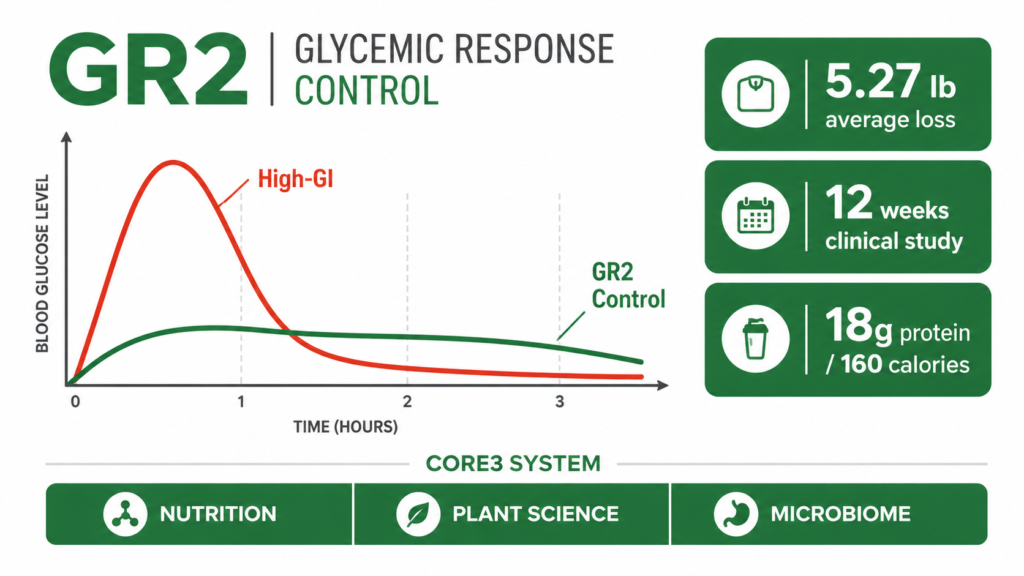
GR2 Technology was developed by Dr. Todd Miller — Ph.D. from Texas A&M University, postdoctoral training at the University of Pennsylvania School of Medicine, Associate Professor at George Washington University, and former Director of the Weight Management and Human Performance Lab. The scientific basis is established in the peer-reviewed literature: elevated postprandial insulin — driven by high-glycemic carbohydrate consumption — promotes glucose uptake into adipose tissue and inhibits lipolysis, directly driving fat storage. GR2 moderates this response by structuring meals around protein and low-glycemic carbohydrates, creating a metabolic environment more favorable to fat oxidation.
A clinical study on the GR2 program documented an average loss of 5.27 lb over 12 weeks — the 12-week timeframe representing the first portion of the NeoFit90 90-day window. The broader weight management research context supports this trajectory: a trial published in the American Journal of Clinical Nutrition (S0002916523046713) found that while low-GI and low-fat diets produced comparable weight loss during the first 12 weeks, BMI reductions were significantly greater in the low-GI group at weeks 16, 20, and 24. This pattern — glycemic advantages compounding over time — is directly relevant to the NeoFit90 90-day duration: the metabolic benefits of GR2’s glycemic control become progressively more pronounced as the program continues.
NeoLifeShake as the GR2 Protein Vehicle
NeoLifeShake’s nutritional profile is specifically designed to function within the GR2 framework: 18g of complete protein in 160 calories, with all 22 amino acids, a PDCAAS score above 1.0 (the maximum theoretical value on the international protein quality standard), and 5g of dietary fiber. The fiber content moderates the glycemic response of the shake itself — consistent with GR2’s emphasis on blunting postprandial insulin spikes. The protein quantity (18g per serving) falls within the range supported by clinical research for satiety optimization and muscle preservation: a 2024 meta-analysis of 47 studies (n=3,218) found that increased protein intake significantly mitigates muscle loss during weight reduction (SMD 0.75; p < 0.001), with effects most pronounced when protein quality (PDCAAS) is high.
NeoLife’s Protogard Process protects amino acids during manufacturing to preserve bioavailability in the finished product — a relevant consideration because standard heat processing can denature heat-sensitive amino acids, particularly lysine, reducing the effective PDCAAS of the finished product below the label value. The Protogard Process is designed to ensure that the amino acid profile listed on the label reflects what is delivered in a bioavailable form — maintaining the PDCAAS above 1.0 through the manufacturing process rather than only in the raw ingredient.
NeoFit90 vs. Conventional 90-Day Programs
The structural differences between NeoFit90 and conventional 90-day weight loss approaches follow from the Core3 framework’s three-layer design. Most 90-day programs address weight management as a calorie and macronutrient equation — targeting caloric deficit and protein adequacy. NeoFit90 adds a third layer that most programs do not address: the cellular nutrition environment in which weight loss occurs. Research published in Obesity Facts (PMC3404899) found that obese individuals have higher baseline micronutrient deficiencies than lean individuals — including vitamin D, vitamin C, selenium, iron, and beta-carotene — and that standard formula diets alone did not correct these deficiencies; in some cases, deficiencies in zinc, vitamin C, and lycopene worsened after three months of formula diet. Pro Vitality+’s four-component system directly addresses the micronutrient, carotenoid, omega-3, and cell membrane gaps that standard meal replacement programs leave uncorrected.
| Program Element | NeoFit90 | Standard Meal Replacement | Calorie Counting Only |
|---|---|---|---|
| Glycemic response framework | Yes — GR2 Technology | Varies — rarely structured | Not addressed |
| Protein quality (PDCAAS) | Above 1.0 — all 22 amino acids | Varies widely | Depends on food choices |
| Cellular nutrition (membrane lipids, carotenoids, omega-3) | Yes — Pro Vitality+ Core3 | No | No |
| Micronutrient deficiency correction | Yes — phytoenzyme-enhanced V&M Complex | Partial — standard RDA levels | Depends on food choices |
| Clinical research documentation | Yes — 5.27 lb avg / 12 weeks; SAB-developed | Varies — often proprietary | General caloric deficit literature |
The omega-3 component of Pro Vitality+ — Salmon Oil Plus, delivering all eight omega-3 fatty acids — addresses a mechanism that most weight management programs do not account for: cell membrane fluidity and insulin receptor sensitivity. Omega-3 fatty acids incorporated into cell membrane phospholipids increase membrane permeability and improve receptor sensitivity — particularly insulin receptors — enhancing the efficiency of glucose uptake and nutrient transport during caloric restriction. Prolonged omega-3 supplementation (beyond 6 weeks) is associated with increased resting metabolic rate and increased fat oxidation at rest and during exercise (StatPearls, NCBI, February 2024) — effects mediated by PPAR transcription factor activity at the gene expression level.
The Cellular Nutrition Foundation: Why Pro Vitality+ Is in Core3
The inclusion of Pro Vitality+ in NeoFit90’s Core3 framework reflects the SAB’s position that weight management outcomes depend on the underlying cellular nutritional environment — not only on caloric arithmetic. This position is supported by the research literature on micronutrient deficiency and metabolic efficiency. A study published in Obesity Facts (PMC3404899) documented that standard formula diets failed to correct baseline micronutrient deficiencies in obese participants — and that some deficiencies worsened over three months. A NWCR-linked study found that even long-term successful weight loss maintainers failed to meet adequate intake for potassium in 90% of cases, confirming persistent nutritional gaps even in motivated, adherent populations.
Carotenoids — delivered in Pro Vitality+ via the Carotenoid Complex — have an independent relationship with metabolic health. A 2024 cross-sectional study (PMID 38639131, Nutrients) found associations between individual carotenoid intakes and metabolic syndrome severity, with lycopene showing an inverse (protective) relationship. A meta-analysis of 11 studies (n=29,673 participants) found an inverse association between total serum carotenoid levels and the presence of metabolic syndrome — suggesting that carotenoid sufficiency is not merely an antioxidant consideration but a metabolic health variable relevant to weight management outcomes.
“There’s more to nutrition than just vitamins and minerals.” — NeoLife Scientific Advisory Board, foundational cellular nutrition philosophy
Tre-en-en Grain Concentrates — the foundational component of Pro Vitality+, developed in 1958 as the world’s first phytonutrient supplement — delivers the lipid and sterol fraction removed from grains during modern milling. Cell membranes require these lipids and sterols to maintain fluidity and permeability. When they are depleted — as in populations consuming predominantly refined grain products — membrane transport efficiency declines. During caloric restriction, when the body depends on efficient cellular nutrient transport to maintain metabolic function on reduced intake, membrane integrity becomes a determinant of how well the reduced nutritional input is utilized. A 1987 Texas A&M study found improved nutrient utilization efficiency in animals receiving the Tre-en-en lipid fraction compared to controls on identical caloric intake — the mechanistic foundation for its inclusion as Core3’s first layer.
Practical Considerations for Nordic Participants
NeoFit90 has specific relevance in the Nordic context given the region’s rising obesity rates and sustainability-oriented consumer preferences. The 2025 Nordic Monitoring Report documents 2024 obesity rates of 15% in Sweden and 24% in Finland — both increased from 2014 baselines, representing a 33% relative increase in aggregate Nordic obesity prevalence within a decade. Structured 90-day programs with documented clinical outcomes address a genuine and growing public health need in markets where conventional dietary advice has demonstrably failed to arrest obesity trends.
The Nordic consumer dimension adds a product selection criterion that most weight management programs cannot address: sustainability credentials. NeoLife’s Golden Home Care product line — biodegradable, phosphate-free, concentrated since the 1960s — means that a household evaluating NeoFit90 can simultaneously address weight management and household chemical reduction within a single distributor registration. The kemikaliebantning (chemical reduction) movement promoted by Swedish government agencies and consumer organizations aligns directly with NeoLife’s overall product philosophy — creating a coherent positioning that addresses both health and environmental priorities within a single brand relationship.
Pricing and access: NeoFit90 products are available at standard retail pricing through the NeoLife shop, or at 20–25% distributor pricing for registered members — with no selling requirements. A single registration covers the full NeoLife product catalog including both nutritional and home care categories. For Nordic participants, the Swedish NeoLife shop provides local pricing and availability.
NeoFit90 in Summary
NeoFit90 applies GR2 Glycemic Response Control Technology — developed by Dr. Todd Miller (Texas A&M Ph.D., University of Pennsylvania postdoc, George Washington University Associate Professor) — within a Core3 framework addressing glycemic response, protein delivery (NeoLifeShake: 18g protein, 160 cal, PDCAAS above 1.0), and cellular nutrition (Pro Vitality+: USDA-partnered research, 37% immune capacity increase in 20 days). The 90-day duration aligns with peer-reviewed habit formation science placing behavioral consolidation at 66 days. Clinical study: average 5.27 lb loss over 12 weeks. European weight management market: $136B (2024).
For the full weight management research context, see the 90-Day Weight Loss Science overview. For the cellular nutrition foundation, see Pro Vitality+.
Frequently Asked Questions
What is NeoFit90 and how does it differ from other 90-day programs?
NeoFit90 is NeoLife’s 90-day body transformation program built on the Core3 framework: GR2 Glycemic Response Control Technology (governing meal composition and timing), NeoLifeShake (18g complete protein in 160 calories, PDCAAS above 1.0, all 22 amino acids, 5g fiber), and Pro Vitality+ (four-component cellular nutrition system). The structural difference from conventional 90-day programs is the inclusion of cellular nutrition — Tre-en-en membrane lipids, broad-spectrum carotenoids, all eight omega-3 fatty acids, and a phytoenzyme-enhanced micronutrient complex. Research shows that standard formula diets do not correct the micronutrient deficiencies prevalent in overweight populations; NeoFit90’s Core3 system addresses this gap as a foundational element rather than an optional add-on.
What clinical evidence supports the NeoFit90 program?
The program has multiple evidence layers. A clinical study on the GR2 Weight Management Program documented an average loss of 5.27 lb over 12 weeks. The broader meal replacement literature supports the approach: a 2019 meta-analysis of 23 RCTs (n=7,884, Astbury et al., Obesity Reviews, PMID 30675990) found meal replacement programs with enhanced support produced −6.13 kg additional weight loss versus conventional diet with support. NeoLifeShake’s protein quality is documented by its PDCAAS score above 1.0 and complete amino acid profile. Pro Vitality+ components have independent research records: Carotenoid Complex has USDA-partnered clinical data (PMID 8147336, Am. J. Clin. Nutr. 1994), Salmon Oil Plus clinical results (17% triglyceride reduction, 38% omega-3 index increase), and Tre-en-en has a 1987 Texas A&M study on nutrient utilization efficiency.
Why is Pro Vitality+ included in a weight management program?
Pro Vitality+’s inclusion in NeoFit90’s Core3 reflects the SAB’s position that weight management outcomes depend on the underlying cellular nutritional environment. Research in Obesity Facts (PMC3404899) found that obese individuals have higher baseline micronutrient deficiencies than lean individuals, and that standard formula diets failed to correct — and in some cases worsened — these deficiencies over three months. Omega-3 fatty acids in Salmon Oil Plus improve cell membrane fluidity and insulin receptor sensitivity, enhancing metabolic efficiency during caloric restriction. Carotenoids show an inverse association with metabolic syndrome prevalence (PMID 38639131, Nutrients 2024). Tre-en-en membrane lipids support cell membrane transport function that determines how efficiently reduced nutritional intake is utilized.
How does GR2 Technology work?
GR2 (Glycemic Response Control) Technology moderates the body’s blood glucose and insulin response following meals. High-glycemic carbohydrate intake drives rapid insulin secretion, which promotes fat storage and suppresses fat oxidation. GR2 structures meals around protein (NeoLifeShake as the primary vehicle), dietary fiber, and low-glycemic carbohydrates — reducing the amplitude of postprandial insulin response. A trial published in the American Journal of Clinical Nutrition found that while low-GI and low-fat diets produced comparable weight loss at 12 weeks, the low-GI advantage on BMI became statistically significant and progressively more pronounced at weeks 16, 20, and 24 — supporting NeoFit90’s 90-day duration as the appropriate timeframe to capture the full benefit of glycemic control.
What is Dr. Todd Miller’s recommended dietary approach within NeoFit90?
Dr. Todd Miller — the researcher behind GR2 Technology (Ph.D. Texas A&M, postdoctoral University of Pennsylvania School of Medicine, Associate Professor George Washington University, former Director of the Weight Management and Human Performance Lab) — recommends the Mediterranean diet as the broader dietary framework within which NeoFit90 operates. The Mediterranean diet is predominantly low-glycemic: high in vegetables, legumes, whole grains, olive oil, and fish; low in processed carbohydrates. A meta-analysis of 16 RCTs (n=3,436, Esposito et al.) found a mean weight reduction of −3.88 kg under energy-restricted Mediterranean diet conditions. No study in this meta-analysis reported weight gain. The Mediterranean framework aligns naturally with GR2’s glycemic control objectives.
Can NeoFit90 be used alongside the Golden Home Care product line?
Yes — they are separate product categories under a single NeoLife distributor registration. Golden Home Care addresses household cleaning with biodegradable, phosphate-free concentrated products; NeoFit90 addresses body transformation through GR2 Technology and Core3 nutrition. Both product categories are available under a single registration providing 20–25% distributor pricing with no sales requirements and no minimum purchase obligations. For Nordic households aligned with the kemikaliebantning (chemical reduction) movement, the combination addresses both health and environmental priorities within a single brand relationship.
Explore NeoFit90
If this page has addressed your questions about NeoFit90, the next step is evaluating the program on its own merits. NeoLife has operated continuously since 1958.
Try the Products First
Start as a customer. No registration, no commitment. Evaluate the products before any business decision.
Distributor Pricing
20–25% lower pricing. No sales requirements. Use it for your household only if that suits you.
* These statements have not been evaluated by the Food and Drug Administration. This product is not intended to diagnose, treat, cure, or prevent any disease. The clinical study result (average 5.27 lb / 12 weeks) reflects program average outcomes and does not guarantee individual results. Individual results depend on adherence, baseline metabolic status, activity level, and other factors. This content is not medical advice — consult a healthcare provider before beginning any weight management program.
Sources:
Astbury et al. (2019) — Obesity Reviews, PMID 30675990 — Meal replacement meta-analysis, 23 RCTs, n=7,884; −6.13 kg vs. diet
Nutrients 2024, PMC11479124, PMID 39408251 — 90-day meal replacement RCT, BMI and body fat outcomes
JMIR 2024, PMC11641623 — Habit formation systematic review, 66-day median stabilization
Appetite 2022, PMID 35787141 — Habit strength and weight regain protection (p ≤ .007)
Carughi & Hooper (1994) — Am. J. Clin. Nutr., PMID 8147336 — Carotenoid Complex bioavailability and immune function
Obesity Facts, PMC3404899 — Micronutrient deficiencies in obese individuals, formula diet effects
Nutrients 2024, PMID 38639131 — Carotenoids and metabolic syndrome cross-sectional study
StatPearls, NCBI (February 2024) — Omega-3 fatty acids, PPAR mechanism, metabolic rate and fat oxidation
Am. J. Clin. Nutr. 2023 — Low-GI vs. low-fat diet, BMI advantages weeks 16–24
Nordic Monitoring Report 2025 — Obesity rates Nordic countries 2024
NeoLife Northern Europe — NeoFit90 and Weight Management product documentation