The Complete Factual Record — FTC Data, Legal
Framework, and the Pioneers Nobody Talks About
Editorial Note: This page presents documented facts about the direct selling industry from government sources (FTC, EU), industry associations (WFDSA, DSA, Seldia), legal records, and peer-reviewed research. No income claims are made. No recruiting language is used. All citations are linked. Where data is disputed or context-dependent, that is stated.
What Direct Selling and Network Marketing Actually Is — And What It Is Not
The World Federation of Direct Selling Associations (WFDSA) defines direct selling as the marketing and sale of products and services directly to consumers away from a fixed retail location, typically through personal contact by independent representatives. This is the foundational legal and operational definition — not the cultural caricature that confuses the category with fraud.
Direct selling divides into two structural models. Single-level marketing generates income from direct sales only — a representative sells a product, earns a commission. Multi-level marketing (MLM) generates income from direct sales plus override commissions on the sales volume of recruited downline representatives. Both are legal. Neither is inherently a pyramid scheme. The legal distinction between legitimate MLM and an illegal pyramid scheme is specific, documented, and has been established by U.S. federal courts since 1979.
The confusion between these categories — legitimate direct selling, legitimate MLM, and illegal pyramid schemes — has been systematically exploited by critics who apply the same label to all three. This page separates them with documented precision.
The Industry by the Numbers — 2023–2025
Global direct selling generated approximately $164 billion in retail sales in 2023, with 104.3 million independent representatives worldwide — 72.1% of whom are women. The WFDSA projects the market to grow from roughly $207 billion in 2025 to $281 billion by 2030, at a compound annual growth rate of 6.3%. Grand View Research estimates the market at $237 billion in 2025, projecting $408 billion by 2033 at 7.1% CAGR.
Wellness products are the single largest category, making up approximately one-third of all global direct selling revenue. The Americas lead in market penetration as a share of GDP, followed by Asia Pacific and Europe.
In Europe, Seldia — the European Direct Selling Association — reported direct selling sales of €32.218 million across the EU in 2024, down 3.2% from the prior year. The EU has 5.4 million independent direct sellers, 76% of whom are women. Wellness is the largest EU category at 17.7% of sales, followed by cosmetics and personal care at 14.2%, household and durables at 13.3%, and home improvement at 12.1%.
In Sweden specifically, IBISWorld data shows the direct selling industry at €798.1 million in 2026, with approximately 4,357 businesses operating. The Swedish market has declined at a CAGR of -4.2% between 2020 and 2025 — a fact that honest evaluation of the Nordic opportunity requires acknowledging.
| Market | Size / Participants | Source | Year |
|---|---|---|---|
| Global retail sales | $164 billion | WFDSA | 2023 |
| Global representatives | 104.3 million | WFDSA | 2023 |
| EU direct selling sales | €32.218 million | Seldia | 2024 |
| EU independent sellers | 5.4 million | Seldia | 2024 |
| Sweden market size | €798.1 million | IBISWorld | 2026 |
| Projected global market | $281–$408 billion | WFDSA / Grand View Research | 2030–2033 |
The Legal Framework: How Courts Define Legitimate MLM
The 1979 Amway Ruling — The Foundational Legal Precedent
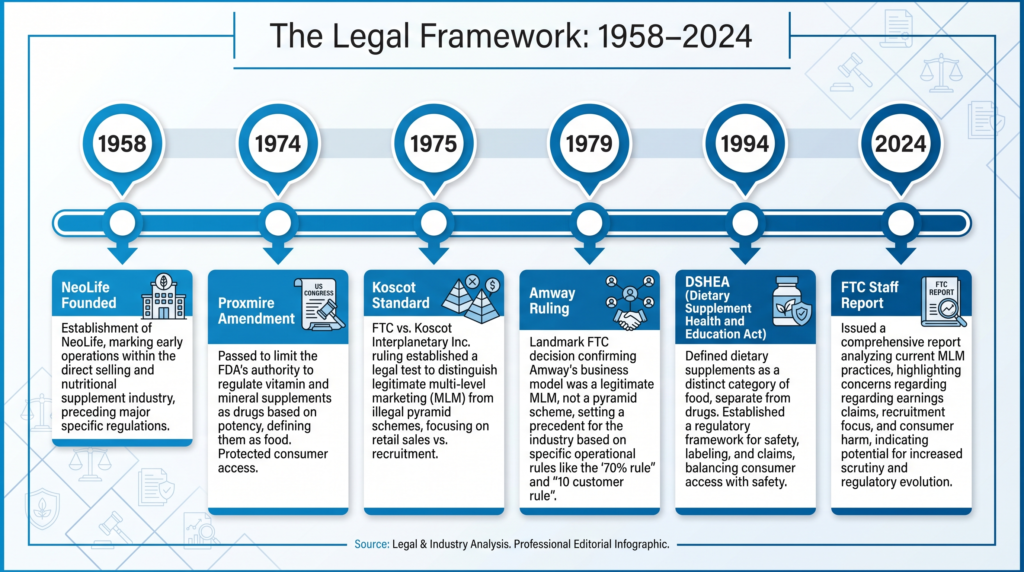
In 1975, the Federal Trade Commission sued Amway Corporation as an illegal pyramid scheme. The case — formally In re Amway Corp., 93 F.T.C. 618 — went through four years of litigation. In 1979, the FTC ruled that Amway’s multilevel marketing plan was a legitimate business opportunity, not a pyramid scheme.
The ruling established what became known as the “Amway Safeguards Rule” — three specific requirements that distinguish legitimate MLM from illegal pyramid schemes: the 70% rule (70% of monthly purchased inventory must be sold at retail before reordering), the 10-customer rule (each distributor must sell to at least 10 retail customers monthly), and a buyback policy for unsold inventory. This 1979 ruling remains the foundational legal precedent by which courts and regulators assess MLM legitimacy today — nearly half a century later.
The Koscot Standard — What Makes a Pyramid Scheme Illegal
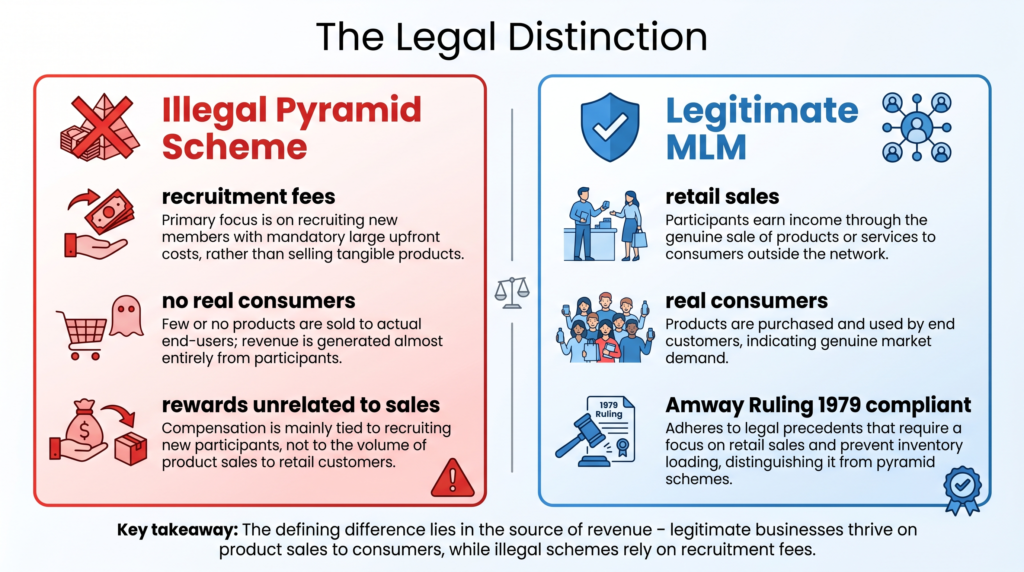
The FTC’s primary test for an illegal pyramid scheme derives from the 1975 Koscot decision. Schemes are characterized by payments for both the right to sell a product and the right to receive rewards “unrelated to the sale of the product to ultimate users.” This is the critical legal phrase. An MLM becomes illegal not because it has multiple levels of compensation, but because its compensation rewards recruitment fees rather than actual product sales to real consumers outside the sales force.
The BurnLounge case updated this standard: a business can sell real products and still be an illegal pyramid scheme if its compensation structure rewards recruitment over retail sales. This nuance is important — the existence of a product does not automatically make a business legitimate. The question is always whether real consumers outside the network are buying the products.
FTC April 2024 Updated Guidance
The FTC published updated business guidance on MLM in April 2024. The agency clarified that it will examine compensation plan design, income claim marketing, and actual participant training — not a simple percentage test. The guidance reinforces the Koscot standard: the central question remains whether participants earn primarily from recruiting new members or from selling products to genuine end consumers.
DSHEA 1994 — How the Supplement Industry Got Its Legal Foundation
The Dietary Supplement Health and Education Act of 1994 reclassified vitamins, minerals, herbs, and nutritional supplements as a separate category from drugs, removing the requirement for FDA pre-market approval. This legislation — championed by Senator Orrin Hatch — significantly expanded the legal landscape for MLMs selling nutritional products, the single largest product category in direct selling.
What is rarely documented is that NeoLife was one of the companies at the center of the multi-decade battle that produced DSHEA. Between 1962 and 1994, NeoLife and a coalition of industry participants fought the FDA’s position that dietary supplements required full pharmaceutical-level control. The Proxmire Amendment of 1974 — championed by Senator William Proxmire — stopped the FDA’s attempt to require prescription status for high-dose supplements. DSHEA 1994 established the permanent legal framework. As NeoLife SAB Director John Miller stated directly: “NeoLife had a big imprint on the industry because of the wars we fought against the FDA. Because of that, billions of people here and around the world have been able to experience the benefits of dietary supplements.”
EU Consumer Protection Framework
In the European Union, the Consumer Rights Directive mandates cooling-off periods and right of withdrawal for direct sales. Seldia — the European Direct Selling Association — operates its own code of ethics as a condition of membership, parallel to the DSA Code of Ethics in the United States. EU consumer protection law applies to direct selling regardless of product category, with specific provisions covering unsolicited sales, cancellation rights, and disclosure requirements.
Pyramid Schemes and Ponzi Schemes: The Documented Record
The conflation of legitimate direct selling with pyramid schemes and Ponzi schemes has done more damage to public understanding of the industry than any other single factor. These are legally and structurally distinct categories. Understanding the documented history of actual fraud cases clarifies the distinction.
What a Ponzi Scheme Actually Is
A Ponzi scheme generates returns for earlier investors using capital from newer investors, with no underlying legitimate business activity. The name derives from Charles Ponzi, who in 1920 defrauded investors of approximately $20 million — equivalent to roughly $250 million today — through a postal reply coupon arbitrage scheme that existed only on paper. He was convicted and deported.
Bernie Madoff’s investment fraud — uncovered in 2008 — was the largest Ponzi scheme in history, involving approximately $65 billion in fraudulent returns over decades. Madoff received a 150-year prison sentence. Neither Ponzi’s scheme nor Madoff’s had any product. They were pure financial fraud with no operational business.
A Ponzi scheme has no relationship to direct selling or MLM. Combining the terms in the same sentence — as critics routinely do — is a category error that the legal and regulatory record does not support.
What a Pyramid Scheme Actually Is
A pyramid scheme involves paying participants primarily for recruiting new participants rather than for selling products or services to genuine end consumers. The FTC’s operational checklist for identifying a pyramid scheme includes: income primarily from recruiting new members rather than product sales; required purchases beyond personal use (inventory loading); no meaningful retail sales to people outside the network; and rewards “unrelated to sale of product to ultimate users.”
| Case | Type | Scale | Outcome |
|---|---|---|---|
| Charles Ponzi (1920) | Ponzi scheme | ~$20M (~$250M today) | Convicted, deported |
| Bernie Madoff (2008) | Ponzi scheme | ~$65 billion | 150-year sentence |
| BurnLounge (FTC action) | Pyramid scheme | — | Operators ordered to pay $17M in refunds |
| Vemma (FTC action 2015) | MLM/pyramid | — | Operations halted, asset freeze, settlement |
| Fortune Hi-Tech Marketing | Pyramid scheme | 350,000+ victims | $7.75M returned, operators banned from MLM |
The Critical Distinction the Media Consistently Misses
Every documented illegal pyramid scheme that has been prosecuted by the FTC shares one characteristic: compensation was structured around recruitment fees paid by participants, not around retail sales to genuine end consumers. The existence of a product does not make a business legitimate. The absence of a product does not make it illegal. The legal question is always the same: where does the money actually come from?
When BurnLounge sold music downloads and still operated as an illegal pyramid scheme, the court’s reasoning was clear — the income structure rewarded recruitment regardless of whether the digital products had any genuine market value outside the distributor network. When Amway was cleared in 1979 despite its multilevel structure, the reasoning was equally clear — genuine retail sales to real consumers outside the network were documented and verifiable.
Income Reality: What the FTC’s 2024 Data Actually Shows
The FTC published a landmark staff report in September 2024 analyzing 70 publicly available MLM income disclosure statements — the most comprehensive government analysis of MLM participant earnings ever conducted. The findings are important and deserve to be stated without softening:
The vast majority of MLM participants earned $1,000 or less per year — less than $84 per month on average. In at least 17 of the 70 MLMs analyzed, most participants earned no money at all. These figures may not account for business expenses including product purchases, marketing costs, and event attendance fees — meaning net income for many participants is negative.
“The FTC’s analysis confirms that most MLM participants earn very little — but the FTC also emphasizes this is not inherently illegal, because a large portion of participants join for product access rather than income. The legally critical question is whether the compensation structure is designed around recruitment rewards versus retail sales.” — FTC Staff Report, September 2024
This is the nuance that both critics and advocates of direct selling consistently miss. The FTC data is damning as an income opportunity for most participants. It is not, in itself, evidence of illegal activity — because the legal question is about compensation structure, not participant outcomes. A business can produce poor income outcomes for most participants and still be a legal business. A business can produce excellent income outcomes for some participants and still be an illegal pyramid scheme. These are separate questions.
The Mean vs. Median Problem
DSA data typically reports average (mean) earnings, which are pulled upward by top earners. FTC data focuses on median (typical) participant experience, which is far lower. The difference between these two statistical measures is the single most important methodological issue in all discussions of MLM income. A company where the top 0.1% earns $514,000 annually and 70% earn under $2,218 annually will report very different numbers depending on whether it presents mean or median figures — and both numbers are technically accurate.
A significant proportion of MLM participants join primarily for product discounts rather than business income. This category of wholesale buyer participants is factored into earnings data in ways that further depress reported averages — because their income goal was never income; it was reduced cost on products they were going to buy anyway. Excluding this group from income analysis produces meaningfully different numbers, and the FTC’s 2024 guidance acknowledges this complexity explicitly.
The Direct Selling Hall of Fame: The Careers Nobody Connects to the Industry
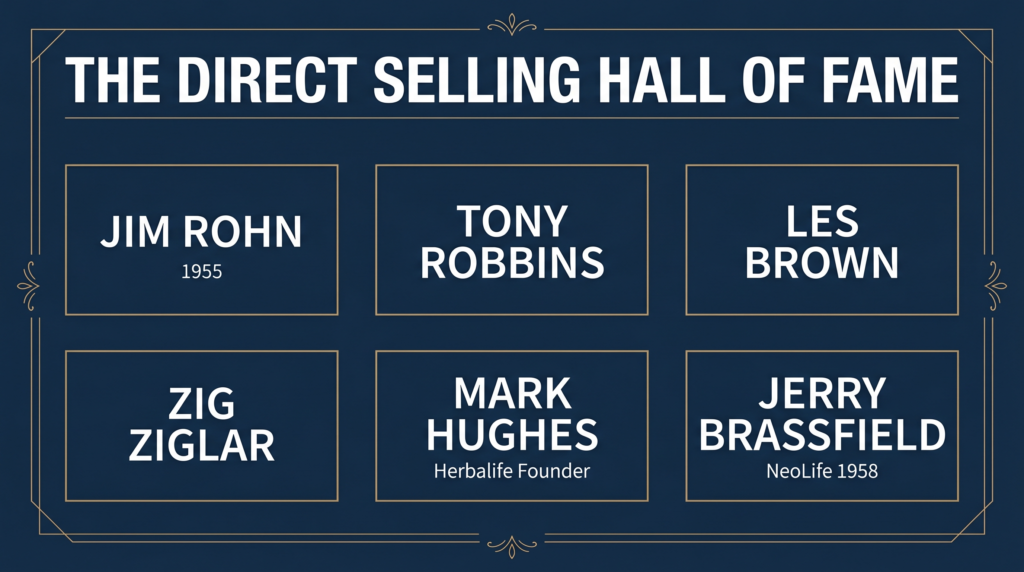
Direct selling has produced a disproportionate number of the most recognized names in personal development, entrepreneurship, and motivational speaking. The connection is rarely documented in their mainstream biographies — but it is factual and verifiable.
Jim Rohn (1930–2009)
In 1955, Jim Rohn joined entrepreneur John Earl Shoaff’s direct selling company AbundaVita as a distributor. He later joined Nutri-Bio, where Shoaff mentored him and Rohn built one of the largest distribution organizations in the company. This direct selling career — starting at age 25, in a nutritional products network — became the entire foundation for his philosophy on personal development, financial independence, and work ethic. He later shared this philosophy across more than 6,000 speaking stages worldwide.
Rohn later joined Jerry Brassfield’s NeoLife distribution network. At 37 years old — an older guy, as Brassfield noted — Rohn was already developing what would become his speaking career. Brassfield and his brother Bob built the Adventures in Achievement tape library around Rohn’s content. When Rohn wanted to leave to become a full-time speaker, Brassfield gave him the entire library — no charge. “We thought he would be independent and we could call him in at any time,” Brassfield recalled.
Tony Robbins
Tony Robbins began his public career promoting seminars for Jim Rohn. Robbins has stated directly that it was Rohn who taught him the core principle he built his empire on: “The secret to life is to come up with a way to add the most value.” The direct selling world was Robbins’ entry point and early professional training ground. Without Jim Rohn’s direct selling career, Tony Robbins’ career trajectory is fundamentally different.
Les Brown
Les Brown — one of the most recognized motivational speakers in the world — was developing his career within Brassfield’s distribution network at the same time as Rohn. The network that produced three of the most cited personal development figures of the 20th century was a direct selling organization.
Zig Ziglar
Zig Ziglar built his speaking philosophy from his experience as a direct salesman — specifically selling cookware for Saladmaster in the 1950s, where he became one of the company’s top performers. His most cited principle — “You can have everything in life you want, if you will just help enough other people get what they want” — is rooted directly in door-to-door, person-to-person direct selling. He later signed up in Brassfield’s network, though his speaking career was already in motion.
Mark Hughes — The Distributor Who Founded Herbalife
Mark Hughes built his early career inside Jerry Brassfield’s NeoLife distribution network. He was successful. He met Jim Rohn. He hired Rohn to work for him. And he left to found Herbalife in 1980 — which became one of the largest MLM companies in the world, eventually facing a $200 million FTC settlement in 2016 that required significant business model restructuring.
Brassfield’s own assessment: “I call that a mistake — that’s the one I really missed.”
Jerry Brassfield — The Pioneer Nobody Talks About
This is the most significant gap in the industry’s documented history. Jerry Brassfield founded GNLD — Golden Neo-Life Diamite, later NeoLife — in 1958 in Porterville, California. He was 19 years old. He borrowed $50 from his brother Bob, who was earning 70 cents an hour repairing television tubes. His initial vision extended approximately 30 miles from his hometown.
Before NeoLife succeeded, Brassfield joined two other nutrition companies — both went bankrupt. He came back a third time, credibility damaged, team reduced, and built a company that has now operated continuously for 65+ years without failure. Along the way, his network produced Jim Rohn, Tony Robbins, Les Brown, Zig Ziglar, and the founder of Herbalife. George Casal — a high school teacher and athlete in his network — became fluent in Italian, Spanish, and Swedish, built NeoLife’s European operations, and eventually served as company CEO.
Brassfield is not on any industry Hall of Fame list. He is not cited in mainstream coverage of the personal development industry. NeoLife is not mentioned in most histories of direct selling despite being one of the oldest continuously operating companies in the category. The company’s philosophy — documented research over marketing claims, facts over testimonials, science over hype — may be precisely why. You cannot build a media presence around “we let the data speak.”
“I believed in the overall dream. I believed in where I was going. I could see the blueprint clearly. I knew that I had to build it. And when it didn’t happen, I didn’t blame the plan, I didn’t blame the company, I didn’t blame anything. I said, ‘You know, I’ve got to work on myself because I can see others doing it. I can do it.'” — Jerry Brassfield, NeoLife Founder
Notable Direct Selling Companies: The Documented Record
| Company | Founded | Revenue | Notable Facts |
|---|---|---|---|
| Avon | 1886 | — | Oldest major direct seller. Filed Chapter 11 bankruptcy 2024. |
| Tupperware | 1946 | — | Filed Chapter 11 bankruptcy September 2024. |
| NeoLife (GNLD) | 1958 | — | Operating continuously for 65+ years. Never failed. SAB since 1976. Helped shape DSHEA 1994. |
| Amway | 1959 | ~$7.7B (2023) | Subject of landmark 1979 FTC ruling that established legal precedent for all MLM. |
| Herbalife | 1980 | ~$4.5B | Founded by Mark Hughes, former Brassfield/NeoLife distributor. $200M FTC settlement 2016, restructuring required. |
The pattern in 50+ year direct selling companies is documented by Edgeworth Economics research: genuine product lines with repeat-purchase customers, compliance programs predating regulatory pressure, and continuous product reformulation based on science. Companies built primarily around recruitment incentives rather than product demand do not survive five decades of regulatory and market pressure.
Ten Misconceptions vs. The Documented Facts
1. “MLM is a pyramid scheme”
Legally incorrect. The FTC explicitly recognizes MLM as a legal business model. The 1979 Amway ruling established the legal distinction. An MLM becomes illegal only when compensation rewards recruitment fees over actual product sales to real consumers outside the network. Calling all MLM pyramid schemes conflates a legal business model with a specifically defined criminal fraud.
2. “Nobody makes money in MLM”
The FTC’s 2024 data shows most participants earn under $1,000 annually — but also documents that many participate primarily for product discounts rather than income. The relevant question is whether the participant’s goal was income or product access. For those whose goal is income, the FTC data is clear: most earn supplemental amounts, and full-time income is achievable for a minority of serious, long-term business builders.
3. “Markets become saturated”
No documented evidence of market saturation exists for product-based direct selling companies. Amway, founded in 1959, generates approximately $7.7 billion annually with 104.3 million representatives operating globally. The WFDSA reports consistent global growth. Saturation is a theoretical concern that the operational data of 60+ year companies does not support.
4. “Products are overpriced”
Direct selling companies carry higher per-unit costs than mass retail due to R&D investment, quality ingredient sourcing, compliance and testing programs, and distributor commission structures. Cost-per-use comparisons — accounting for concentration, potency, and efficacy — rather than price-per-unit are the documented methodology for fair comparison in the supplements and home care categories. A concentrated cleaning product that produces 11 litres of ready-to-use solution from one litre costs more per litre than a diluted ready-to-use alternative — and less per use.
5. “Only top earners benefit”
The FTC data confirms that income is highly concentrated at the top. It also confirms that a large proportion of participants are not primarily seeking income — they are seeking product access at wholesale pricing. These are different value propositions and should be evaluated separately. Product discount value is real, calculable, and does not depend on recruiting anyone.
6. “Direct selling exploits relationships”
This criticism applies to high-pressure recruitment tactics that DSA-member companies’ codes of ethics explicitly prohibit. The DSA Code requires approved training materials, fair pricing, full income disclosure, and prohibition of inventory loading. Companies that violate these standards face DSA removal. The behavior described by critics is documented as a code of ethics violation, not as a feature of the business model.
7. “The company makes money from distributor purchases, not consumer sales”
This is the legally critical question — and it is the right question to ask of any direct selling company. Where a company’s revenue derives primarily from distributor purchases rather than end consumer sales, the FTC’s Koscot standard becomes relevant. This is precisely why the FTC examines retail sales data in MLM investigations. Legitimate companies can demonstrate genuine end-consumer demand. This is the correct test to apply.
8. “Pyramid schemes and Ponzi schemes are the same thing”
They are not. A pyramid scheme involves recruitment fees and false product demand within a closed network. A Ponzi scheme involves fabricated investment returns with no underlying business activity. Charles Ponzi and Bernie Madoff ran Ponzi schemes — financial fraud with no product. BurnLounge and Fortune Hi-Tech ran pyramid schemes — businesses with nominal products but compensation structures that rewarded recruitment. These are distinct fraud categories with different legal definitions and different prosecutorial frameworks.
9. “Regulation proves the industry is fraudulent”
Regulatory attention proves the industry is large enough and visible enough to attract regulatory attention — as every major industry does. The existence of FTC enforcement actions against specific MLMs proves that the FTC has the authority and willingness to act against legitimate violations. It does not prove that all MLMs violate the law. The same regulatory framework that shut down BurnLounge cleared Amway in 1979 and has not shut down NeoLife in 65+ years of operation.
10. “Direct selling is an outdated model”
104.3 million active representatives globally in 2023 and projected growth to $281–$408 billion by 2030–2033 do not characterize an outdated model. The model has evolved: digital platforms, social selling, and e-commerce have changed how direct sellers reach customers. The fundamental principle — product recommendation through personal relationship and trust — has become more relevant as consumer skepticism toward mass advertising has increased.
The Nordic Market: Specific Context
Sweden and Finland rank among Europe’s most conscious purchasing markets. Nordic consumers demonstrate documented preference for: transparency in ingredient sourcing, environmental impact reduction, science-backed product claims, and brands with verifiable sustainability credentials.
The kemikaliebantning movement — systematic reduction of household chemical exposure — has driven significant behavioral change in Nordic households. This creates a documented consumer demand for certified, low-toxin household and personal care products. Direct selling companies whose product lines were formulated around these principles decades before regulatory mandates emerged hold a positioning advantage that newer entrants to the category cannot replicate through marketing alone.
Sweden’s direct selling market at €798.1 million in 2026 has declined at -4.2% CAGR between 2020 and 2025. This is the honest market context. It reflects broader retail trends, digital shopping behavior changes, and post-pandemic behavioral shifts — not a specific rejection of direct selling products. Wellness remains the largest category in EU direct selling at 17.7% of sales, which is the relevant category for nutrition-focused direct sellers in Nordic markets.
What Separates Sustainable Direct Selling Companies
Edgeworth Economics research and FTC guidance converge on documented differentiators for direct selling organizations that sustain operations across decades:
Product-first orientation: Sustainable organizations are built around genuine consumer demand for the product. When the product generates repeat purchases from consumers who have no financial relationship with the company — who are not distributors, not recruits, not members of the sales force — the business has a foundation that does not depend on continuous recruitment. This is the single most important operational indicator of long-term legitimacy.
Retail sales to non-participants: The proportion of sales to people outside the sales force is the primary legal and practical health indicator. This is what the FTC measures. This is what separates Amway from BurnLounge. This is what the 1979 ruling was about.
Product quality and repurchase rate: Long-term customer retention depends on voluntary reordering — customers who buy again because the product works, not because they have financial incentive to maintain status. Companies with 50+ years of operation have demonstrated this in the only way that matters: continuous operation.
Scientific oversight: Companies that have invested in independent scientific advisory boards, peer-reviewed research programs, and third-party quality verification have built infrastructure that supports product credibility independent of distributor claims. This infrastructure cannot be faked across six decades of operation.
Transparent earnings disclosure: The FTC’s 2024 analysis of 70 income disclosure statements was only possible because legitimate companies publish them. Pyramid schemes do not publish income disclosure statements — because their income data would immediately reveal the recruitment-over-sales structure. Publication of honest, complete income data — including the median, not just the mean — is the behavioral marker of a company that is not afraid of what the data shows.
Frequently Asked Questions
Is MLM legal?
Yes. Multi-level marketing is a legal business model explicitly recognized by the FTC and operating under the legal framework established by the 1979 Amway ruling. MLM becomes illegal when its compensation structure rewards recruitment fees over actual retail sales to genuine end consumers outside the sales force — the Koscot standard established in 1975. The legal test is always about compensation structure, not about whether multiple levels of commission exist.
What is the difference between a pyramid scheme and a legitimate MLM?
The legal distinction established by the FTC is specific: in an illegal pyramid scheme, rewards are “unrelated to sale of product to ultimate users.” In a legitimate MLM, income derives from actual product sales to genuine consumers outside the distributor network. The existence of a product does not automatically make a business legitimate. The question is whether real consumers outside the network are buying the products because they want the products — not because they are participants in the compensation plan.
How much do most MLM participants earn?
The FTC’s September 2024 staff report analyzing 70 MLM income disclosure statements found that the vast majority of participants earned $1,000 or less per year — under $84 per month on average. In at least 17 of the 70 MLMs analyzed, most participants earned nothing. These figures may not account for business expenses. The FTC also notes that many participants join for product access rather than income, which affects how earnings data should be interpreted.
Is Direct Selling and Network Marketing the same as door-to-door sales?
Direct selling encompasses door-to-door sales but is not limited to it. The WFDSA definition covers any sale to consumers away from a fixed retail location through personal contact by independent representatives. This includes in-home demonstrations, party plan selling, social selling through digital platforms, and personal referral-based sales through apps and websites. The channel has evolved significantly while the fundamental principle — product recommendation through personal relationship — has remained consistent.
Why do Ponzi schemes get associated with MLM?
The association is a cultural conflation rather than a legal or structural one. Both involve money changing hands through networks of participants. Beyond that, the structures are entirely different. A Ponzi scheme has no legitimate business activity — returns are fabricated from new investor capital. An MLM has real products sold to real consumers. The conflation persists because both generate skepticism, and skepticism tends to collapse categories. The legal and regulatory record treats them as entirely separate categories, which they are.
What happened to Tupperware and Avon?
Both Tupperware and Avon Products Inc. filed for Chapter 11 bankruptcy protection in 2024. Tupperware’s filing in September 2024 ended 78 years of continuous operation. Avon Products Inc.’s filing followed years of declining sales. Both companies faced structural challenges including digital retail competition, changing consumer shopping behavior, and distributor recruitment difficulties. Their failures are not evidence that direct selling is invalid — they are evidence that specific companies with specific structural challenges can fail within a legal and viable industry.
What is the DSA Code of Ethics?
The Direct Selling Association’s Code of Ethics is a condition of membership that requires DSA member companies to maintain approved training materials that sellers cannot be required to purchase, fairly priced sales aids, full disclosure of income potential, a prohibition on inventory loading, and a buyback policy for unsold inventory. The DSA has a process for consumer complaints and can remove members who violate the Code. DSA membership is not a government certification — it is an industry self-regulatory mechanism — but it imposes documented behavioral requirements.
The Complete Record in SummaryDirect selling is a $164 billion global industry with 104.3 million participants, governed by legal precedent established in 1979 and updated by FTC guidance in April 2024. The industry is not a pyramid scheme. Pyramid schemes are a specific, legally defined fraud category that the FTC has prosecuted successfully in documented cases including BurnLounge, Vemma, and Fortune Hi-Tech Marketing. Ponzi schemes — Charles Ponzi, Bernie Madoff — are a separate and unrelated fraud category. The income reality for most participants is supplemental rather than primary, as the FTC’s September 2024 staff report documents clearly and honestly. The industry produced Jim Rohn, Tony Robbins, Les Brown, and Zig Ziglar — and the distribution network that produced them was run by a 19-year-old from Porterville, California who borrowed $50 from his brother, failed twice, and built a company that has never failed in 65+ years of continuous operation. That company is not on any Hall of Fame list. It lets the data speak. For the specific NeoLife business opportunity — earnings data, compensation mechanics, and who it realistically suits — see the NeoLife Business Opportunity page.
Explore the NeoLife Opportunity
If this page has addressed your questions about the industry, the next step is evaluating a specific opportunity on its own merits. NeoLife publishes its earnings data annually and has operated continuously since 1958.
Try the Products First
Start as a customer. No registration, no commitment. Evaluate the products before any business decision.
Distributor Pricing
20–25% lower pricing for regular users. No sales requirements. Use it for your household only if that suits you.
Sources: FTC Business Guidance on MLM (April 2024); FTC Staff Report on MLM Income Disclosures (September 2024); WFDSA Global Direct Selling Statistics 2023; Seldia European Direct Selling Report 2024; IBISWorld Sweden Direct Selling Market Report 2025–2026; Grand View Research Direct Selling Market Report 2025–2033; In re Amway Corp., 93 F.T.C. 618 (1979); DSA Code of Ethics; Edgeworth Economics Journal of Direct Selling Research (January 2025). This page does not constitute legal or financial advice. Individual results in direct selling vary based on personal effort, market conditions, and time investment.