
Why Neolife’s 68-Year Story Matters in 2026
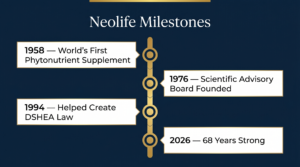
Neolife history stretches back to 1958 — a time when the supplement industry barely existed and the concept of cellular nutrition was unknown to most consumers. Understanding where Neolife started helps explain why the company stands apart from the hundreds of nutrition brands that have appeared and disappeared in the decades since.
Most supplement companies are built around a product. Neolife was built around a philosophy — the idea that true nutrition happens at the cellular level, and that science, not marketing, should drive every formulation decision. That founding principle has shaped everything from the company’s earliest grain concentrate supplements to its current global product line.
This pillar page traces Neolife’s journey from its 1958 founding through its Scientific Advisory Board, its pioneering research collaborations, and its evolution into a company whose heritage aligns directly with what today’s most demanding consumers are looking for: bioavailability, transparency, and environmental responsibility.
The 1958 Foundation: Jerry Brassfield and a Personal Mission
Neolife’s origin is not a corporate story. It is a personal one.
Jerry Brassfield grew up struggling with health challenges. His mother, determined to help, began giving him high-quality nutrition supplements. The difference it made was significant enough to change the direction of his life. That experience gave him a conviction that would shape everything that followed: good nutrition has the power to transform people’s health — and most people have no idea where to start.
That conviction became Neolife. Founded in 1958 under the name GNLD (Golden Neo-Life Diamite), the company was built from day one around a single mission: helping people feel better, live healthier, and take control of their wellness. Not through marketing claims, but through products that actually worked — backed by science serious enough to stand behind.
The company’s earliest product, Formula IV, already reflected this philosophy. It included grain-derived lipids and sterols alongside vitamins and minerals — compounds that would later be formalized as the Tre-en-en concept. The reasoning was straightforward: modern grain processing strips out the lipid and sterol fraction that cells depend on to maintain membrane flexibility and efficient nutrient transport. Formula IV was designed to restore what processing had removed.
In the same year, Neolife introduced what company literature describes as the world’s first phytonutrient supplement: Tre-en-en Grain Concentrates. Derived from wheat germ, rice bran, and soybeans, Tre-en-en delivered essential fatty acids, plant sterols including beta-sitosterol and gamma-oryzanol, and octacosanol — all in a form designed to support cellular membrane integrity from the ground up.
The company also moved early into biodegradable household cleaners, introducing its Golden Home Care line with products like LDC (Light Duty Cleaner) in the 1960s. At a time when environmental impact was not a mainstream concern, Neolife was already formulating with biodegradable surfactants and phosphate-free chemistry — a commitment that would prove far ahead of its time.
Dr. Arthur Furst and the Scientific Advisory Board
Who Was Dr. Arthur Furst?
The most consequential decision in Neolife’s early history was the establishment of its Scientific Advisory Board (SAB) in 1976, led by Dr. Arthur Furst. Understanding who Furst was explains why the SAB carried real scientific weight rather than functioning as a marketing credential.
Arthur Furst (1914–2005) earned his undergraduate degree in chemistry from UCLA in 1937, his Master’s degree from Stanford in 1940, and his PhD from Stanford in 1948. He later received an honorary Doctor of Science in toxicology from the University of San Francisco. He founded the Stanford Cancer Chemotherapy Laboratory and is widely recognized as a pioneer in toxicology and cancer research, contributing to early oral chemotherapy drug development at a time when cancer treatment was in its infancy.
Furst served as Senior Member of the Neolife Scientific Advisory Board for approximately 25 years. Company and academic sources consistently describe him as the scientific inspiration behind many of Neolife’s product innovations. The University of San Francisco recognizes him as the “Father of Modern Toxicology” — a title that reflects the breadth and influence of his career beyond his work with Neolife.
What the SAB Was Built to Do
The Scientific Advisory Board was not established as a figurehead committee. From its founding, the SAB operated around three explicit standards that continue to govern Neolife’s product development today:
Purity — systematic screening for contaminants across raw materials and finished products, with an emphasis on choosing whole-food ingredient sources with documented safety profiles.
Potency — using ingredients at clinically relevant levels derived from whole-food sources rather than synthetic isolates, based on the premise that the food matrix affects how nutrients are absorbed and utilized.
Proof — requiring support via published or peer-reviewed research rather than relying solely on in-house data or anecdotal evidence.
The SAB’s remit extended across both Neolife’s nutritional supplements and its home-care products. For the home-care line, this meant an explicit emphasis on biodegradable surfactants and a commitment to avoiding chemicals that persist in the environment — a standard that anticipated regulatory directions by decades.
The Science Behind Cellular Nutrition
What “Cellular Nutrition” Actually Means
Neolife’s core concept — cellular nutrition — is not a marketing phrase. It describes a specific approach to supplementation based on how cells actually function at the membrane level.
Cell membranes are semi-permeable structures that require specific lipids and sterols to maintain the flexibility needed for efficient nutrient transport. When membranes lack these compounds, they become rigid. Nutrients that should enter the cell are blocked. Metabolic waste that should exit accumulates. The cell’s ability to use available nutrition — regardless of how much is consumed — is compromised.
Modern grain processing removes the lipid and sterol fraction from grains during milling. A person eating a diet that meets standard vitamin and mineral recommendations may still be deficient in the cellular-level compounds that determine how efficiently those nutrients are actually used. This is the gap that Tre-en-en was designed to address from the company’s founding year.
The Texas A&M Research
One of the most cited studies supporting the Tre-en-en cellular nutrition model was conducted at Texas A&M University in 1987. A series of seven-week rat studies compared animals fed standard chow — meeting vitamin and mineral requirements — against animals whose standard lipid fraction was replaced with Tre-en-en grain concentrates.
Despite similar caloric intake across groups, the Tre-en-en group showed superior growth, faster maturation, and better overall development. The researchers interpreted this as evidence of improved nutrient-utilization efficiency: the animals were getting more from the nutrition they consumed, not more nutrition in absolute terms. The Tre-en-en group also showed more developed cardiovascular systems and higher adrenal activity, suggesting greater capacity to respond to physiological stress.
These studies involve animal models rather than human clinical outcomes — an important distinction that Neolife’s own scientific communications have acknowledged. The mechanistic basis they provide for the cellular nutrition concept is consistent with broader membrane biology literature, where lipid composition is well-established as a determinant of membrane fluidity and transporter function.
Carotenoid Complex: Peer-Reviewed Human Research
The most extensively documented area of Neolife’s third-party research involves its Carotenoid Complex — a mixed carotenoid supplement derived from tomatoes, carrots, spinach, bell peppers, apricots, strawberries, and peaches.
Research conducted by USDA-affiliated scientists showed that supplementation with a mixed carotenoid formulation increased immune parameters in women, including lymphocyte proliferation and natural killer cell activity. The same research indicated that the mixed carotenoid supplement produced greater immune benefits than beta-carotene alone — a finding consistent with current understanding of carotenoid synergy.
A placebo-controlled, double-blind trial published in the Journal of the American College of Nutrition examined women on a low-carotenoid diet. The study found elevated malondialdehyde-thiobarbituric acid (MDA-TBA) levels — a marker of lipid peroxidation — in the placebo group, and that supplementation with the Neolife mixed carotenoid product normalized these levels. The implication was protection against oxidative damage to lipids.
An animal study published in the Nigerian Journal of Physiological Sciences compared the Neolife Carotenoid Complex against carrot-derived carotenoids in Wistar rats and found that the Neolife formulation produced significantly greater increases in lymphocytes, monocytes, and platelet counts.
These studies appear in peer-reviewed outlets including the Annals of the New York Academy of Sciences, the American Journal of Clinical Nutrition, Free Radical Biology and Medicine, and the Journal of the American College of Nutrition — mainstream nutrition science publications rather than company-owned channels.
Neolife vs. Other Nutrition Brands: What the Heritage Record Shows
| Criteria | Neolife | Typical Supplement Brand | Pharmaceutical-Grade Brand |
|---|---|---|---|
| Founded | 1958 | Typically post-1990 | Varies |
| Independent Scientific Board | Yes — since 1976 | Rarely | Sometimes |
| Third-party peer-reviewed research | Yes — USDA, universities | Rarely | Sometimes |
| Cellular nutrition philosophy | Core since 1958 | Not typically | Not typically |
| Biodegradable home care line | Yes — since 1960s | Rarely | Not applicable |
| Bioavailability as explicit standard | Yes — SAB mandate | Increasingly common post-2020 | Yes |
| Transparency on ingredient sourcing | Whole-food sources documented | Variable | Usually high |
The Golden Home Care Line: Environmental Responsibility Before It Was Expected
Neolife’s household cleaning products — particularly LDC (Light Duty Cleaner) and Super 10 — represent a parallel track of innovation that is easy to overlook when discussing the nutrition story but is central to understanding the company’s founding philosophy.
LDC is a concentrated, neutral-pH cleaner that is fully water-soluble, phosphate-free, and formulated with 100% biodegradable surfactants. At a 1:5 dilution for general cleaning, a single one-litre bottle yields approximately six litres of ready-to-use solution — reducing both cost per use and packaging waste significantly compared with conventional ready-to-use products.
Super 10 is a more concentrated industrial-strength all-purpose cleaner that can be diluted from 1:3 for heavy-duty degreasing to 1:10 for light household cleaning. At a 1:10 dilution, one litre of Super 10 effectively replaces approximately 11 litres of conventional ready-to-use cleaner — and can substitute for multiple specialized products (kitchen cleaner, bathroom cleaner, degreaser) with a single formula.
The environmental arithmetic is straightforward. Avoiding 6–11 conventional one-litre HDPE bottles per concentrate bottle prevents roughly 240–440 grams of plastic per purchase cycle. Life-cycle assessments of HDPE suggest a carbon footprint of approximately 1.8–3.1 kg CO₂-equivalent per kilogram of virgin resin, meaning each concentrate bottle avoids an estimated 0.4–1.4 kg CO₂-equivalent in packaging alone. The U.S. Environmental Protection Agency has reported that concentrated cleaning products can reduce plastic packaging by up to 70% compared with ready-to-use formulations.
Neolife’s Position in the 2025–2030 Market
Several trends converging in the mid-2020s make Neolife’s founding heritage directly relevant to current market conditions rather than merely historically interesting.
The global dietary supplements market is projected to reach $414.5 billion by 2033, with bioavailability and enhanced-absorption formulations identified as a core growth driver. Consumer skepticism about whether label claims translate into actual absorbed doses is pushing the industry toward exactly the kind of proof-of-plasma-response standard that Neolife’s SAB has required since the 1970s.
In Scandinavia specifically, the concept of “kemikaliebantning” — literally “chemical dieting,” or systematically reducing household exposure to hazardous chemicals — has become mainstream. Swedish consumer organizations, municipalities, and NGOs actively guide households toward biodegradable, toxin-reduced alternatives. The Swedish government’s “Giftfri miljö” (non-toxic environment) policy goal and EU chemical policy tightening under REACH represent a regulatory environment that Neolife’s product philosophy anticipated by decades.
The Nordic professional cleaning products market is projected to grow from approximately 984 million in 2024 to roughly 1.4 billion by 2034, driven by demand for biodegradable, low-VOC, eco-labelled solutions. A 2024 consumer sustainability report found that 58% of Nordic consumers rated sustainability as important when buying products — a figure that has shifted sustainability from a differentiator to what researchers now call a “hygiene factor”: a baseline expectation rather than a premium feature.
Neolife and the UN Sustainable Development Goals
Neolife’s product portfolio maps directly onto four of the UN’s 17 Sustainable Development Goals — a framework that is increasingly used by institutional buyers, distributors, and informed consumers to evaluate brand credibility.
SDG 3 — Good Health and Well-Being: Neolife’s whole-food nutritional supplements, immune-supportive phytonutrients, and cellular nutrition approach address diet-related risk factors and micronutrient gaps in a population where processed food has displaced nutrient-dense whole foods.
SDG 6 — Clean Water and Sanitation: The Golden Home Care line’s biodegradable surfactants and phosphate-free formulations minimize water pollution from household cleaning — a documented contributor to aquatic ecosystem disruption in conventional cleaning products.
SDG 12 — Responsible Consumption and Production: Concentrated formats that replace multiple single-use products, reduce packaging waste, and extend the useful life of existing containers directly support the circular economy principles at the heart of SDG 12.
SDG 13 — Climate Action: Packaging reduction, lower transport weight per unit of cleaning delivered, and biodegradable chemistry collectively reduce the carbon footprint of household maintenance — a small but measurable contribution at scale.
Who Is Neolife For?
Health-focused consumers who want science behind the label. If you’ve grown skeptical of supplement brands that list impressive milligrams without evidence of absorption or efficacy, Neolife’s peer-reviewed research record and SAB oversight offer a different standard. The Carotenoid Complex studies, in particular, provide the kind of published, third-party evidence that most supplement companies do not have.
Families reducing chemical exposure at home. The Golden Home Care line’s biodegradable, phosphate-free formulations are designed for households where reducing toxic exposure — particularly for children — is a priority. The concentration model also reduces the number of specialized products needed, simplifying the cleaning cupboard while lowering cost per use.
Network marketers looking for a brand with defensible differentiation. In a direct-selling environment where product claims are often difficult to verify, Neolife’s 68-year track record, published research, and founding scientific philosophy provide concrete talking points that go beyond testimonials.
Sustainability-minded consumers in Scandinavian and European markets. Neolife’s positioning on biodegradability, concentration, and reduced packaging aligns with the “kemikaliebantning” movement and EU regulatory direction in ways that many competing brands are only beginning to address.
Neolife may not be the right fit for consumers primarily seeking the lowest per-unit price point, or those looking for the widest possible product variety under one brand. The company’s strength is depth of scientific grounding rather than breadth of SKUs.
Frequently Asked Questions
Who founded Neolife and when?
Neolife was founded by Jerry Brassfield in 1958 under the name GNLD (Golden Neo-Life Diamite). Brassfield’s personal experience with nutrition as a child — and the dramatic difference quality supplements made to his health — drove him to build a company dedicated to helping others access the same benefits. The company’s first products, Formula IV and Tre-en-en Grain Concentrates, were both built around the cellular nutrition philosophy that continues to define Neolife today.
What is the Neolife Scientific Advisory Board?
The Scientific Advisory Board (SAB) was established in 1976 by toxicologist and cancer researcher Dr. Arthur Furst. It functions as an independent scientific oversight body that governs product formulation standards across Neolife’s nutritional and home-care lines. The SAB’s three core standards are Purity, Potency, and Proof — requiring that products meet documented quality and research criteria rather than relying solely on internal development.
What is Tre-en-en?
Tre-en-en is a grain concentrate supplement introduced by Neolife in 1958, described in company and product literature as the world’s first phytonutrient supplement. It provides lipids and sterols from wheat germ, rice bran, and soybeans — compounds that support cell membrane flexibility and nutrient transport efficiency. The product is positioned as restoring what modern grain processing removes from the diet.
Does Neolife have independent clinical research?
Yes. The most extensively documented area is the Carotenoid Complex, which has been studied in research conducted by USDA-affiliated scientists and published in peer-reviewed journals including the Journal of the American College of Nutrition and the American Journal of Clinical Nutrition. Tre-en-en has been studied in animal research at Texas A&M University. These are third-party studies rather than exclusively in-house publications.
How does Neolife relate to sustainability trends in Scandinavia?
Neolife’s Golden Home Care line — with its biodegradable surfactants, phosphate-free chemistry, and concentrated formats — aligns directly with the Swedish “kemikaliebantning” movement and EU chemical policy goals. The company’s approach to concentration (reducing plastic packaging and transport emissions per unit of cleaning delivered) also connects with Nordic sustainability expectations and the UN SDG 12 framework for responsible consumption.
What is the difference between Neolife and GNLD?
GNLD (Golden Neo-Life Diamite) was the company’s original name, used for much of its history. Neolife is the current brand name. The underlying company, product philosophy, Scientific Advisory Board structure, and core formulations remain continuous from the 1958 founding through the current operation.
Is Neolife a network marketing company?
Yes. Neolife distributes its products through a direct-selling network marketing model. This means products are typically available through independent distributors rather than retail channels. The business model provides an income opportunity for distributors alongside the product offering — a structure that has been in place since the company’s founding.
Summary: A 68-Year Foundation Built for 2026
Neolife’s history is not simply a timeline of product launches. It is the record of a company that committed to cellular nutrition, independent scientific oversight, biodegradable chemistry, and proof-based formulation standards at a time when none of those things were industry expectations — and has maintained that commitment across nearly seven decades.
The convergence of bioavailability as a mainstream supplement concern, “kemikaliebantning” as a Nordic consumer movement, and transparency as a baseline expectation for Gen Z and younger consumers means that Neolife’s founding philosophy is more commercially relevant in 2026 than it has been at any previous point in the company’s history.
The pages linked below explore each dimension of the Neolife story in depth — the science behind cellular nutrition, the research record on specific products, the environmental economics of the home care line, and the business opportunity for distributors.